

Saving the Island’s Garry Oaks
By Jon Bach • Photography by Anne Abernathy
The saying, to “miss the forest for the trees,” takes on a literal meaning for the founders and supporters of Oak Harbor’s Garry Oak Society (OHGOS) as they raise awareness for what they believe is one of the most important tree species on Whidbey Island—the Garry oak. The numbers of Garry oaks has severely declined over the last 200 years due to development and economic activity, invasive species such as ivy, advancing conifer trees, and even other oak species that threaten the Garry oak’s DNA because of wind hybridization.
“Yes, you can plant an acorn, but you need to have a few things thought out first—space, sunlight, and protection from predators,” said Laura Renninger, president of the OHGOS and a fourth generation Oak Harbor resident. “It is our only native oak and [the species] needs help from people to protect the old ones and plant new ones.”
For islanders and visitors, perhaps the most obvious awareness of this native tree is the city of Oak Harbor itself—named for the Garry oak. The tree’s scientific name, Quercus garryana, was coined by David Douglas—a botanist in the early 1800s—to honor Nicholas Garry, an officer in the Hudson Bay Trading Company. The Garry oak is also known as the Oregon oak, Oregon white oak, or just white oak.
Garry oaks can grow to more than 60 feet high, sometimes having trunks of 40 inches in diameter. Most have a single trunk, but some produce two or more. The bark is one of the tree’s most distinctive features, with thick and rough silver-grey furrows. When you see a mature tree, the branches take many twists, sometimes even corkscrewing as the tree grows. This deciduous tree’s leaves are leathery, with shiny, dark green tops and yellowish-green undersides.
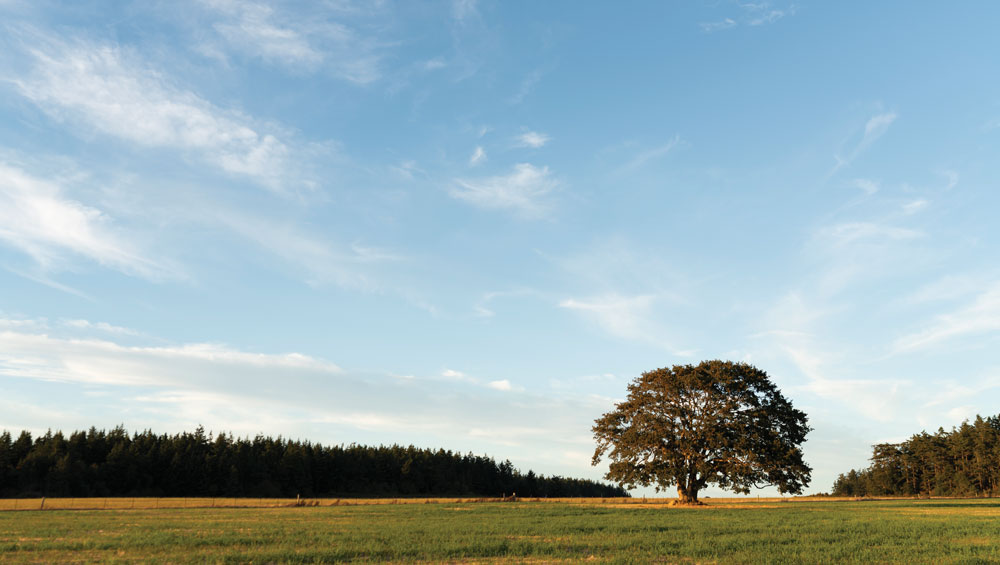
Since the Garry Oak Society was founded in 2015, the all-volunteer group has successfully planted and protected hundreds of Garry oaks, while sharing ideas for conservationism and education. They help transplant seedlings, have developed advocacy relationships with officials, and participate in tree maintenance. In addition to this, they have established scholarships, created management plans, made presentations throughout the community, and have partnered with conservation groups like the Whidbey Camano Land Trust. The group also hosts craft sales at Oak Harbor’s Garry Oak Gallery on Pioneer Way.
For Laura Renninger, the most rewarding part of their involvement is seeing the young oaks they’ve planted grow, and the reactions from the public who have been involved in the process. “[They say] ‘the tree I planted three years ago, it’s starting to look like a tree now.’”
It’s a family endeavor for Renninger, whose son Kyle is also a board member and Director of Special Projects for the OHGOS. As a fifth generation Oak Harbor resident, he grew up beneath the oaks. “Smith Park was the closest city park, and I spent a lot of time there,” he recalled. “The oaks have a really special place in my heart, but also a really special place ecologically as you learn more about them.”
His turning point came in 2015 when he came home to find that the 330-year-old Garry oak tree at the Oak Harbor Post Office had been cut down the previous year. He asked his mother Laura, “So where are the new trees?”
For Renninger and her son, it’s important that people know the Garry oak is a culturally significant tree. Indigenous islanders not only harvested acorns as a dietary staple from Garry oak meadows, but camas root and chocolate lily grew within the rich, understory ecosystems created by the Garry oak trees.
To better understand the intrinsically important relationship with this special species, OHGOS encourages people to take part in a self-guided Garry oak tour. Created in partnership with the City of Oak Harbor and the Oak Harbor Chamber of Commerce, this 90-minute tour covers 1.75 miles across quieter Oak Harbor streets, with 10 dedicated stops next to prominent city landmarks, including Windjammer Park and City Hall. On the trail, you’ll see a wide range of Garry oaks, from young saplings to the oldest on the island. You’ll even see a Garry oak in the middle of SE 8th Ave—famously protected by local historian and journalist Dorothy Neil from the city’s plan to cut it down.
“A lot of the places where they once grew are now our towns, homes and businesses,” said Kyle Renninger. “The oaks don’t grow as fast as other trees and aren’t always commercially available in nurseries, but now, more than ever, we need people to plant them.”
For more information about the Oak Harbor Garry Oak Society and how you can help protect the Garry oak, visit
ohgarryoaksociety.org.


