

Deeply Ingrained Collaboration
By Allyson Meyer • Photos by Dave Meyer
Barn swallows flit through the pre-dusk light, their quick, almost spontaneous movements, juxtaposed with the stillness of a pre-storm summer evening. Standing on Ebey Road Farm, taking in the sweeping views of the Olympic mountain range and the sprawling fields, it’s almost as if you’re stepping into a bygone era of farming, where the history is palpable with each breath. But although the past may be evident everywhere you look on this six-generation family farm, these islanders are committed to an agricultural future that ties in collaboration, entrepreneurship, and environmentalism.
“The cool part about being a sixth-generation farmer is you do understand the ethic it takes to continue operation. You’re caretaking this place for another generation. And part of that is running a successful business,” said Clark Bishop. “On the one hand, it’s super unique. On the other hand, it’s just like any other farm—it has a host of challenges.”

“We want to do things right and we care about the land. We care about what we do. We care about the quality of our product.”
But with those challenges, come opportunities for problem solving and flexibility that have been a part of the farm’s century-plus existence. On their land within Ebey’s Landing National Historical Reserve, purchased by the family’s ancestors around 1886, Clark, and his wife Danielle, are carving out a new farming path that puts the future front and center, all while taking a cue from the past.
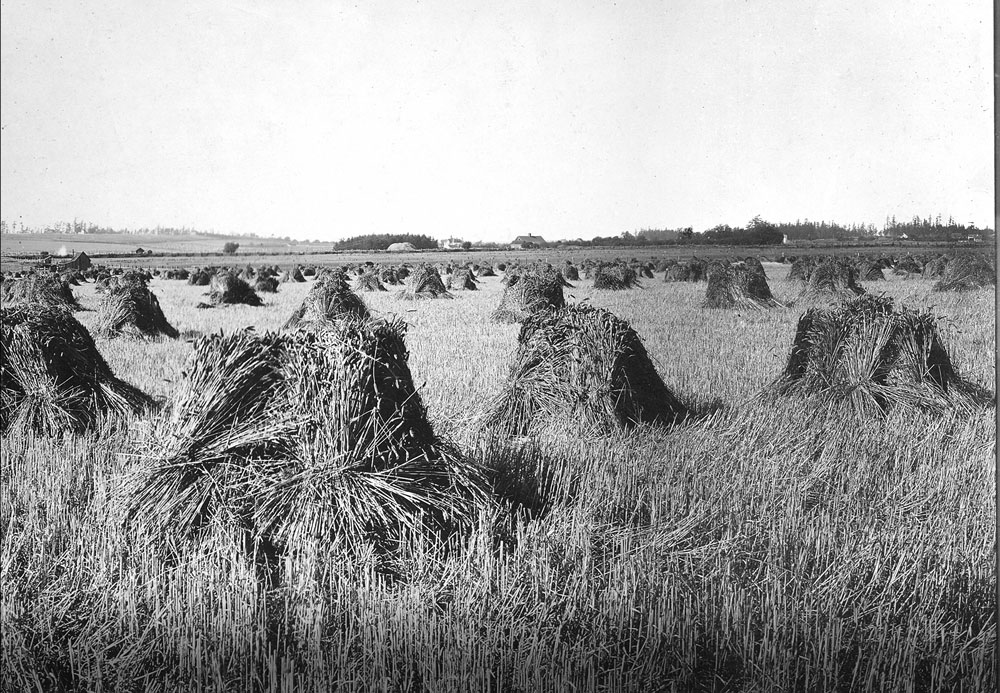
“Clark’s great great grandfather had been growing wheat in the early 1900s,” said Danielle. “I think what makes wheat growing fun for us is that in 1919, John LeSourd actually took second place in a national wheat growing competition and had the second highest yield of wheat in the entire country.”
But over the years, the farm had moved from wheat to different crops and livestock, and was a large milk supplier for Darigold for more than 40 years. In 2008, the farm transitioned from a dairy farm with its iconic Holstein milking cows to a diversified crop farm, growing crops for animal feed on about 600 acres.
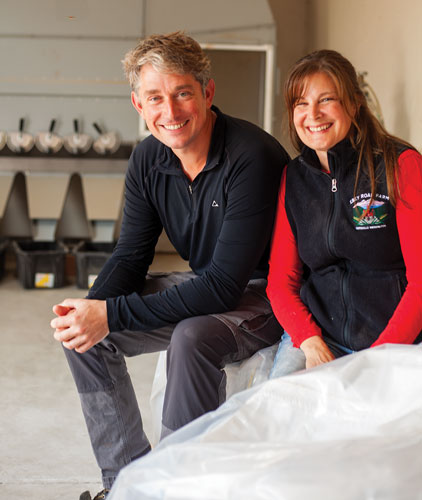 Clark and Danielle Bishop, Ebey Road Farm
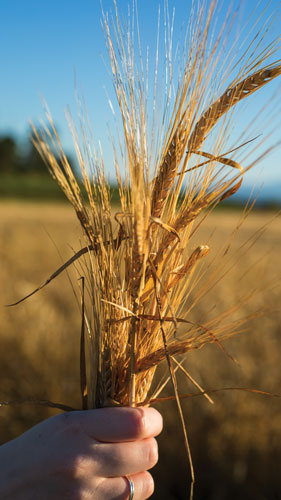 Shock of Red Russian wheat grown at Ebey Road Farm
In 2017, Ebey Road Farm pivoted again, joining Little Red Hen Bakery co-owners Tyler and Sara Hansen and Patrick Goldacker in a partnership that gave new meaning to the phrase farm-to-table—in this case, it was locally grown and milled wheat that could be used in the bakery. In 2024, Goldie’s and The Roost, an artisanal pizza restaurant and cocktail and wine bar in Coupeville, joined the partnership with their pizza dough made with flour from Ebey Road Farm wheat. Together, these three businesses are putting community and passion towards ethically delicious foods, one grain at a time.
“Many years ago, we had dinner with Danielle and Clark to kind of plant the seed of growing wheat,” said Sara. “And because it takes a long time to get into a grain man’s heart, you just have to keep pestering him. Clark finally let us plant some wheat in the first field and we bought it all. Then he agreed to do it again and now it’s built into this beautiful partnership.” The bakery bought the wheat and the partnership expanded from that original field. In 2025, the farm planted 17.4 acres, yielding around 27 tons of wheat, all of which is milled locally and used by the bakery.
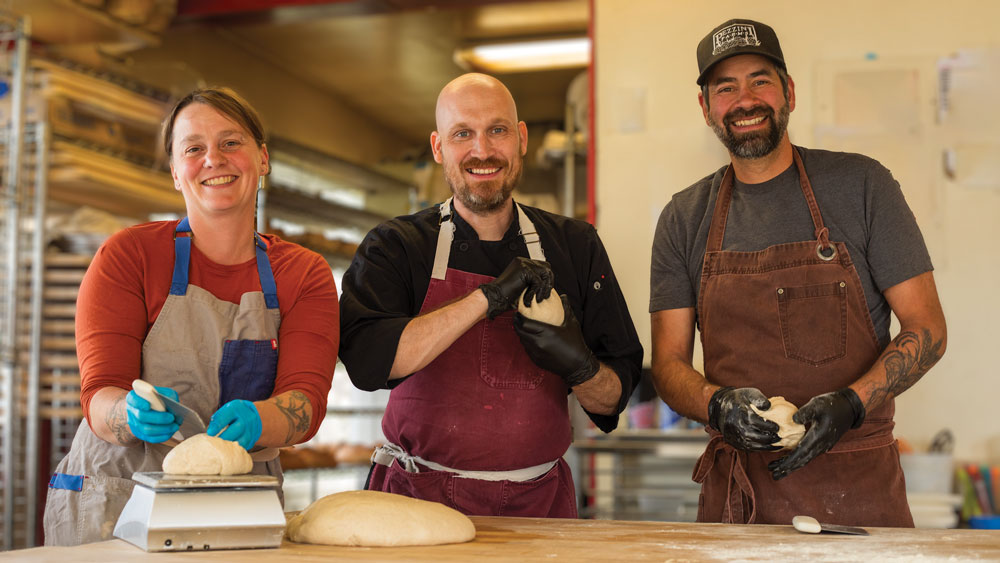 Sara Hansen, Patrick Goldacker, and Tyler Hansen, Co-Owners Little Red Hen Bakery
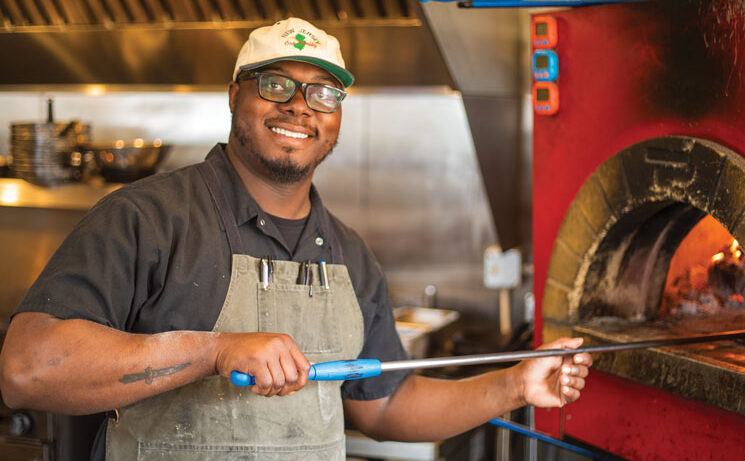 Sedrick “Seddy” Livingston, co-owner of Goldie’s and The Roost
Today, the farm works with the Washington State University BreadLab to test plots of wheat for growing in the Pacific Northwest, developing new varieties better suited for the island climate. This program enabled the Bishops access to Red Russian wheat, an heirloom variety, which Clark believes was the crop grown by his ancestor back in the early 1900s.
“We had a history with Red Russian, and I thought it was cool,” said Clark. “But it grows to be about seven feet tall in a good year and has iron straw and chokes a combine like nothing else.” But the farm has persisted, with the wheat making up 100 percent of the flour used in the pizza dough Little Red Hen supplies to Goldie’s.
It’s a commitment to an heirloom variety you can actually taste. “I think a lot of modern-day varieties of wheat get bred for yield and standardization and they start losing some of the taste qualities that come with wheat,” said Danielle. “It’s important for the quality of the wheat,” added Tyler. “The nutritional value is something that hasn’t been changed or modified for whatever reason to make it a higher yield or better commodity while sacrificing the actual quality of the wheat.”
And for Sedrick “Seddy” Livingston, co-owner of Goldie’s and The Roost, it’s quality that makes all the difference. “Fresher ingredients make it easier. You can taste what you’re doing, and you get instant satisfaction,” he said. “It’s nice to know the people who you’re dealing with. They’re just a hop, skip, and a jump away.”
In a little over a year, Goldie’s has become a bustling community hub. For Seddy, it’s all because of the local collaboration. “I’m the newest person around town, so I really want to show my appreciation for all the love and acceptance that happened immediately, bringing me into this community and letting me be a part of the growth, showcasing how amazing these people are,” he said. “It is a badass island, that’s for sure.”
It’s this community spirit that is intrinsic to the partnership, with the wheat traveling less than two miles from farm, to bakery, to restaurant. It’s a unique component, with the collaboration local at its core.


