

Grace Under Sail
By Lea Cramer • Photos by Jamie Conners
On a crystalline morning in Coupeville, the Schooner Suva rocks gently in Penn Cove, her century-old Burmese teak hull catching light like burnished gold. Crafted in 1925 in the shipyards of Hong Kong, the Suva was designed by Seattle naval architect Ted Geary and commissioned by Frank Pratt, an attorney who had abandoned the East Coast for the quiet waters of Whidbey Island. She was built for pleasure, not speed or commerce. Shipwrights crafted her from ancient teak and fitted her with Sitka spruce masts. At 65 feet overall length with a 14-foot beam, Suva is a relic of a bygone era—a vessel of quiet proportion and enduring poise.
However, time bows to no man, regardless of rank or region. War came. Pratt died. Suva’s elegant gaff rig gave way to modern demands, her classic silhouette trimmed and tweaked. A diesel engine was grafted in—less poetry, more practicality, a mechanical heart transplant for survival. The decades turned, and beauty, stripped of utility, fell out of favor.
By the early 2000s, the inevitable had occurred: a dowager empress found herself listed online for sale among paddleboards and jet skis. Suva, near forgotten, seemed more legend than vessel.
In 2015, the Whidbey Island Maritime Heritage Foundation stepped in—a band of local sailing enthusiasts with veneration in their veins and salt on their sleeves. They bought Suva and began the painstaking toil of restoring her. Like all wooden vessels, she’s temperamental and high maintenance. Wooden boats split, swell, shrink. They require varnish, vigilance, and devotion. Most marinas today shimmer with flashy fiberglass, but Suva—defiantly elegant—refuses to go unnoticed. Her repairs were meticulous, expensive, and relentless. Restorers replaced the horn timber with purpleheart, an exotic hardwood known for its deep purple color when exposed to the elements. Volunteers carefully see to her care plank by plank, against worm and rot. They repaired her Burmese teak hull and shaped a new propeller. The steadfast crew measures Suva’s value not in metrics but in meaning.
To board Suva is to step into maritime history. There is no tour script, no piped-in narration, no costumed reenactment—only the hiss of water against the hull, the snap of the sail, and the creak of wood.
To board Suva is to step into maritime history. There is no tour script, no piped-in narration, no costumed reenactment—only the hiss of water against the hull, the snap of the sail, and the creak of wood. Time slows. She invites presence. Inside, her salon and cabin glow like honey, yielding to hand-rubbed varnish. She smells of linseed oil, salt, and legacy.
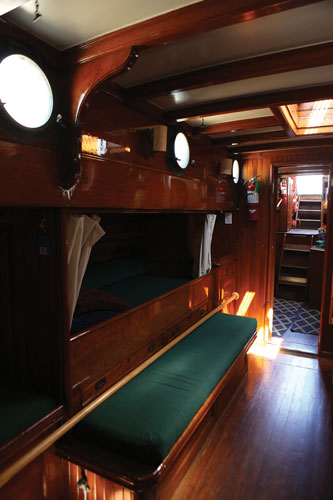 Interior cabin of the Schooner Suva
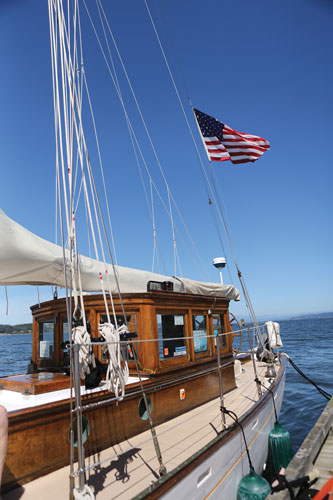 Looking toward the stern of Schooner Suva with U.S. flag in the gentle breeze
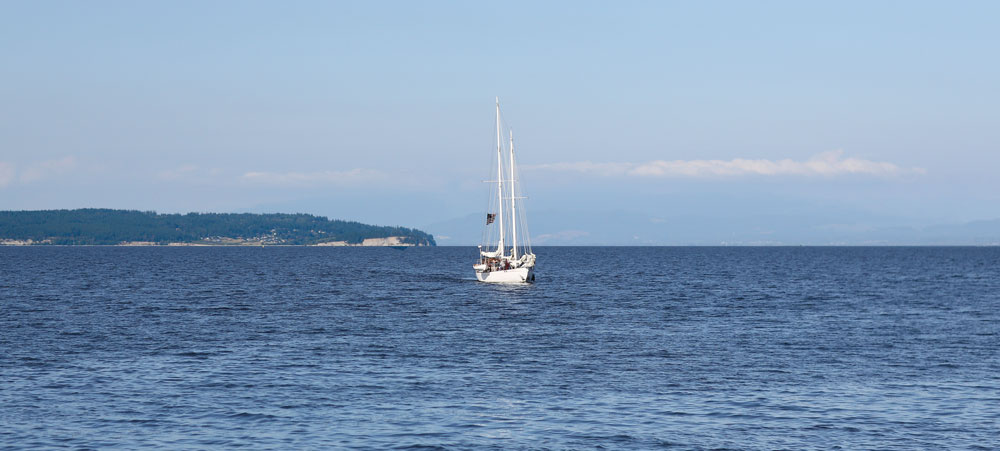 Schooner Suva sails neer Penn Cove Washington
Suva leaves Coupeville Wharf most weekends from June through September, slipping across Penn Cove—a bay that offers glimpses of harbor seals, sea stars, and orcas if you’re lucky. “She’s been sailing in this neck of the woods forever,” said Tim Neal, a volunteer of eight years and a Whidbey Island Maritime Heritage Foundation board member. He gestures down the cove. “Pratt lived right over there. Suva was moored down there. He liked to take his friends out.” The scene he describes—a man, a boat, a body of water, and the luxury of time—sounds almost mutinous today.
Up the hill, the Island County Historical Museum has assembled an exhibit in honor of Suva’s recent centennial celebration. There are photographs from the 1920s, brass fittings, faded blueprints, and logbooks that smell faintly of mildew and memory. However, the actual schooner functions less as an artifact and more as a community elder. She is not guarded behind red velvet ropes or interpretive signs. She has life. She teaches. She engages. She reminds people that heritage, like teak and spruce, survives through care.
Like all wooden vessels, she’s temperamental and high maintenance. Wooden boats split, swell, shrink. They require varnish, vigilance, and devotion.
There’s something subversive about a vessel that defies a culture that prizes instant gratification and the new. Suva’s survival is not a feat of engineering but scrupulous attention to detail. She endures because people show up—to scrape, caulk, fundraise, and sail. Not all the volunteers are sea-vetted sailors. Some had never hoisted a halyard. But they saw Suva’s value and stayed.
Her educational mission is both noble and necessary. Gary McIntyre, her senior captain and operations board member, says kids come aboard jittery, overstimulated, and hungry for distraction. When they touch the wheel and feel the boat answer, something shifts. “For some kids, it’s life changing.”
Shipwrights are aging, and their knowledge is endangered. But Suva floats because members of the Whidbey Island Maritime Heritage Foundation remember what it means to work with their hands and, more importantly, how to love what they’ve made. They are passionate about sharing their knowledge, skills, and admiration for Suva and the sea with the next generation.
Aboard Suva, time isn’t counted in minutes. It’s counted in the lull between gusts, the creak before a tack, the moment someone realizes they’ve stopped checking their phone. In the end, Suva doesn’t promise adventure. She offers something rarer: connection. To place, to past, to the moment.
As afternoon light slants across Penn Cove, volunteers prepare her for another voyage. On Mondays, the four rotating captains and their deckhands, all volunteers, exercise their skills. Their movements are nimble and practiced, like dancers, they pivot around the deck, grabbing halyards, bracing, and balancing. A newly certified bosun calls out to her sailors. This isn’t performance. It’s purpose. The wind picks up, the sails fill, and Suva begins to move with the kind of grace that can only come from perfect harmony between human intention and natural force.
Over the next two hours, time will stretch and soften. Minutes will melt into moments. She’s not just a boat that’s outlived empires and fashion trends, Suva’s a living legend with sails. Her raked masts lean into the breeze like a stanza in motion, each sail a line of poetry composed in canvas and light. She doesn’t rush—she glides, as if the sea itself steps aside to let her pass out of respect.
Suva reminds us that meaning isn’t always found in the destination but in the quiet joy of the journey. Perhaps that, in the end, is the most radical thing about Suva: in an age of artificial urgency, she insists on the revolutionary act of taking time.


