

A Conservatory Grows Wild on Whidbey
By Lea Cramer
Summer days on South Whidbey Island begin with the shimmer of a sunrise filtering through fir trees and mist lifting off the Salish Sea. It’s here—between woodlands and tidal inlet—that a unique partnership has taken root that blends theatre, wilderness, and childhood imagination. The Youth Summer Conservatory, a youth theatre camp for pre-teens, was launched by the Whidbey Island Center for the Arts (WICA) more than a decade ago. It was reestablished in 2024 after the COVID-19 pandemic with a new collaboration model with the Whidbey Institute.
The program merges WICA theatrical know-how and mainstage resources with the contemplative hush of the Whidbey Institute’s 106-acre campus, a landscape of cedar, spruce, and soft footpaths. Under the umbrella of WICA’s Arts Education program—home to improv, Bluegrass, and youth initiatives—the Conservatory has become a connector between performance training and nature immersion, between the gallery and the glade.
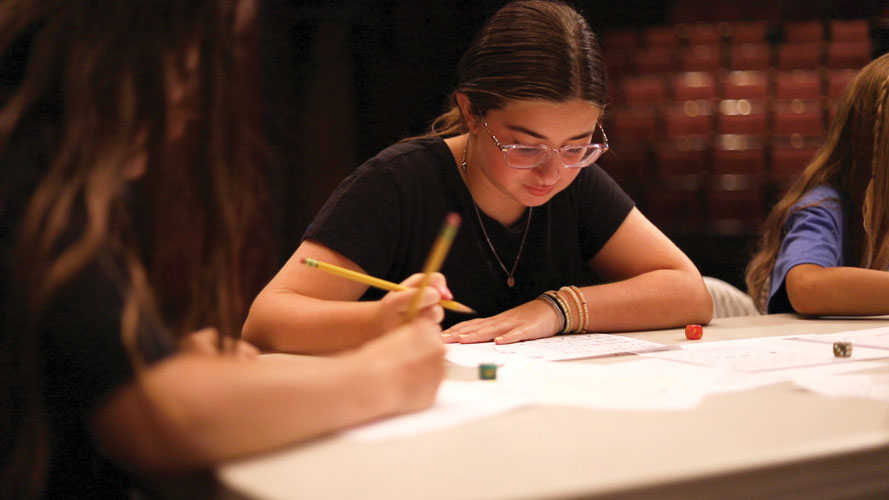
The schedule is purposeful, with the first part of the camp unfolding on WICA’s campus. Young actors learn how to hit a mark on the stage and keep a pace. In the shop and backstage, skilled crafters steady young hands at paint tables and workstations, showing how ideas transform into objects that enhance a performance. The second part of the camp shifts to the Whidbey Institute and the StoryHouse Stage—a timbered amphitheatre nestled in moss and sword fern—where lines are memorized beneath the chatter of chickadees and the maritime breeze in the treetops is reminiscent of applause. The alternation—studio and stage, wood and wind—creates an uncommon synthesis: theatrical discipline infused with ecological awe. It is not simply a stage with trees nearby, but a practice that includes the land as a participant and collaborator, a celebration of site, narrative, and creativity. In 2025, the students reimagined Alice in Wonderland not as a dive down a rabbit hole but across misty meadows and mossy trails of Whidbey’s enchanted landscape.
“Over the years, we’ve dreamed together about what’s possible when art, community, and nature converge. This conservatory is the result of that dreaming.”
For WICA’s Executive Artistic Director Deana Duncan, the partnership is the natural expression of an institutional aim. “Our mission is to impact lives through powerful shared experiences in the arts—that is the long-term impact we are striving for,” she said. “Our hopes are based on the long-term influence of our Youth Conservatory and our dream that all kids will have access to quality arts education and experiences.”
“Over the years, we’ve dreamed together about what’s possible when art, community, and nature converge,” added Rose Woods, the Whidbey Institute’s executive director. “This conservatory is the result of that dreaming.”
This collaboration is both inspired and practical. WICA, founded in 1996, is an integral part of the island’s artistic backbone, offering a year-round calendar of theatre, dance, music, arts, and humanities events, and festivals like DjangoFest Northwest. The Whidbey Institute, with its spacious gathering halls and green sanctuaries, provides a haven for reflection and change. The combination of both is magical.
“Theatre is about collaboration and coming together as artists to create something larger than ourselves,” said the program’s lead teacher Katie Kammerer. “It can teach us so much, at any age.”
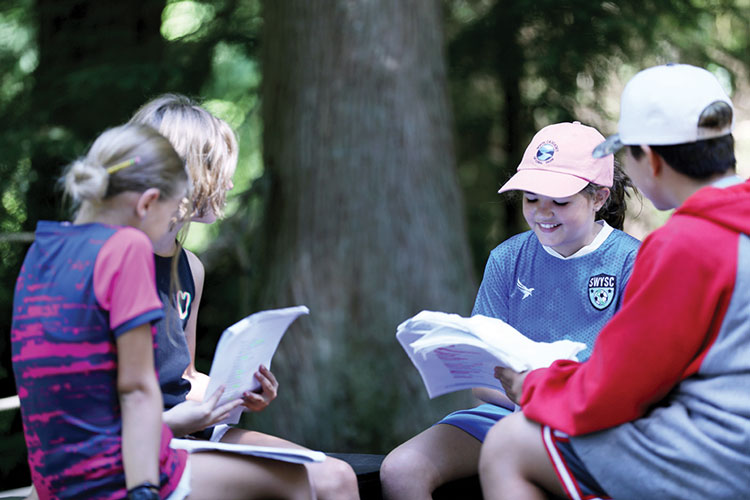 Young actors rehearsing for the production of Alice in Wonderland
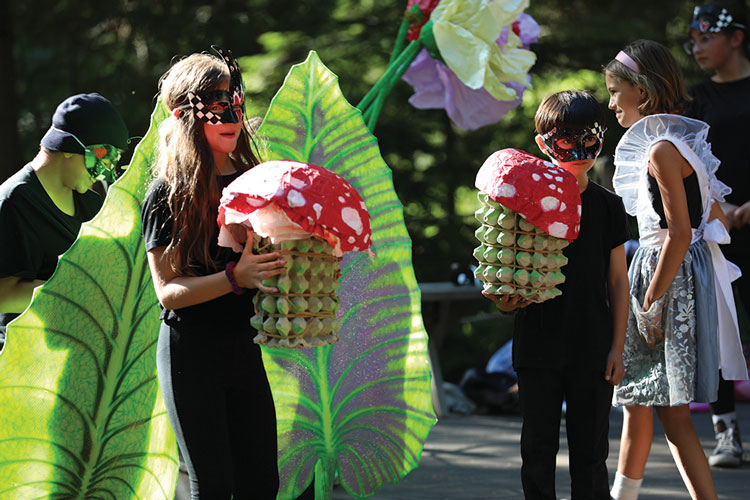 Young actors taking part in the theatre production of Alice in Wonderland
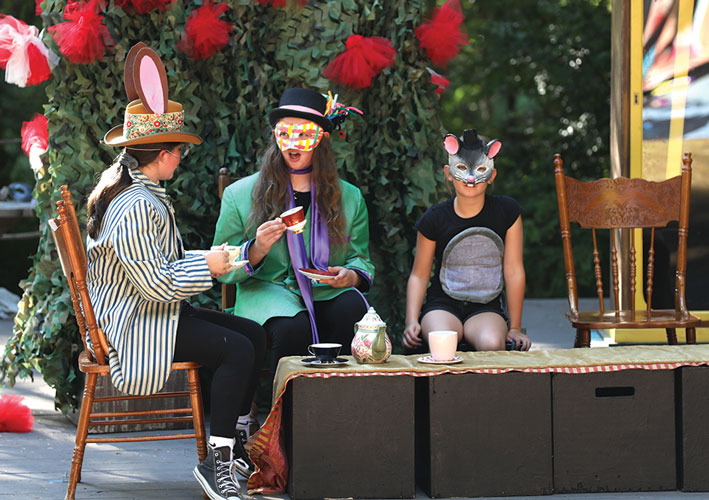 Young actors on stage in the theatre production of Alice in Wonderland
“We believe every child deserves the chance to be seen, heard, and celebrated,” added Woods. “Our shared hope is to grow this into a lasting pillar of Whidbey Island’s cultural and educational landscape.”
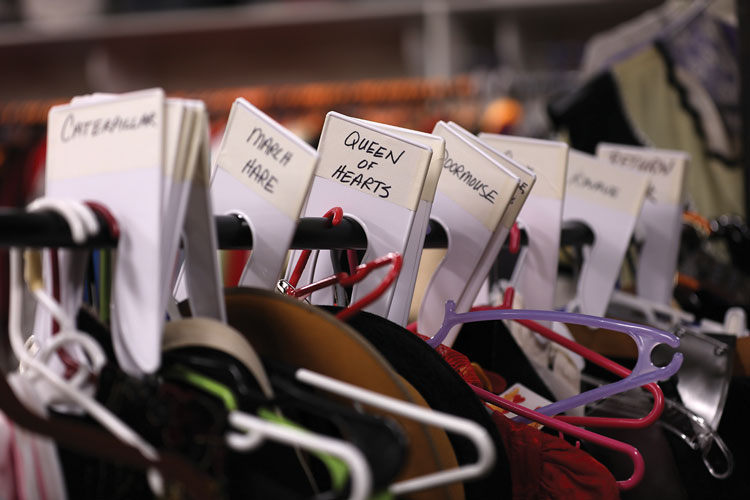
Mentorship undergirds the magic. The costume shop does more than produce sparkle; it passes on craft. Costume designer Randon Pool, who upcycled a pink, sparkling serpent into a caterpillar that could command a forest clearing, has a teacher’s instinct to impart knowledge. “As a costume designer, I’m always looking for someone to ‘download’ my skillset onto—a younger person hungry to learn,” she said. The camp offers something rare—a place where a running stitch, a painted mask, or a well-placed fastener becomes an initiation, and where the work of the hand returns to the center of theatrical expression. Each day unfolds amid stages, forests, and fields—children gathering in circles to practice, play, and connect. Alice in Wonderland feels like the perfect encapsulation of all of this—a story shaped by curiosity, courage, and change.
Neither a typical conservatory nor a rustic retreat…where technique meets timber, and youthful exuberance echoes between floorboards and forest canopy.
Many picture a youth conservatory inside a school auditorium or a black box theatre. On Whidbey, the land becomes an equal partner. The StoryHouse Stage sits among firs and ferns, catching the last light; the soundscape is layered with thrushes, ferry horns, and applause. Students rehearse on a hill, needles and cones underfoot. It is not art amid nature so much as art within it, the place dictating tempo and tone as surely as any director. The results are transformational. Inside, voices are tentative at first. Outside, they soar. In the wild, growth accelerates: blocking turns to navigation, costumes ride the wind, and the campers’ collaboration becomes second nature in the open air.
The conservatory concludes with three public performances. Intimate in scale but ambitious in scope. The word is spreading. Students return—excited, articulate, unafraid. If there is a lesson here—for artists, educators, and environmentalists—it’s this: young performers crave structure and surrender. They draw cues from directors, thrive in dappled daylight, and inhabit real and imagined worlds with equal energy. Here, they are encouraged to explore both. The Youth Summer Conservatory is neither a typical conservatory nor a rustic retreat. It’s a hybrid: where technique meets timber, and youthful exuberance echoes between floorboards and forest canopy. Here, on a small Pacific Northwest island, children learn to trust their voices—not just on polished stages, but in amphitheatres shaped by cedar and salt air. They are the future of the arts, and have found their home among creative expression.
To learn more about the Youth Summer Conservatory, visit WICAonline.org/summer-conservatory.


