Preserving Whidbey’s Prairie History for the Future
by Jon Bach • photos by Jamie Conners
Midway up the island, just north of the Washington State Route 525 and 20 split, there’s a nonprofit dedicated to the preservation, restoration, and sustainability of native plants and the Whidbey prairie. For the Pacific Rim Institute for Environmental Stewardship (PRI), it begins with understanding the island’s past and future and that every ecological link, from grass to butterfly, makes a difference to food and culture.
Founded in 2009, PRI’s mission is focused on “engaging science, culture, and community for ecological restoration.” Much of the work centers around partnerships with “scientific and academic institutions, churches and local tribes, [and] governmental and nonprofit organizations to understand, protect, and restore the endangered westside prairies.” For the organization, this work may begin on their preserve but includes efforts throughout the Salish Sea.
 Giant White Fawn-Lily
 Pretty Shooting Star
The ancestral lands of the Coast Salish Indigenous Peoples, the Whidbey Island prairie was settled by Euro-American pioneers who arrived in the mid-1800s. The preserve’s property went through various owners and uses until 2015 when PRI purchased it. Today, this land is used for the study, cultivation, and preservation of the native prairie. According to PRI, native prairies like Whidbey’s once covered thousands of acres in the Puget Sound. Today they’re considered among the most endangered natural systems in the United States, almost all lost to tree and shrub invasion as well as agriculture and housing development.
Islanders and visitors are encouraged to help restore the natural balance unique to the Pacific Northwest. Volunteers are welcome at PRI to help with preservation and restoration efforts, and anyone can buy native plants to take home and plant in their yard—plants like Golden Paintbrush, Nodding Onion, Lomatium, Woolly Sunflower, Chocolate Lily, and Pretty Shooting Star.
 Chocolate Lily
 Camas
Camas
Brenda Cunningham manages a display garden for the Washington Native Plant Society, which hosts two plant sales a year and relies on PRI for its “sun-loving” native plants. “We’ve had the great fortune of working with PRI for many years,” Cunningham said. “Their expertise in growing native plants has helped us provide a wide range of pollinator plants in our spring and fall plant sales, and the species diversity they have learned to propagate is great for us. They’re always looking for ways to help us get more native plants into the hands of [residents] throughout our region.”
This is exactly what PRI Land Steward Mosa Neis wants to hear. She finds it rewarding to go out and have conversations with people about local preservation and sustainability. “It’s been amazing in the ten years I’ve been here. The interest from the public about native plants and pollinators and what we’re doing has been exponential.” She and her colleagues work to monitor and sustain various areas of the 175-acre preserve, ever aware of the growth and decline that occurs naturally and constantly watching for invasive plants and finding appropriate ways to eradicate intrusions. “There will always be challenges,” Neis said. “But the point is to focus on what can be done. We need organizations, partners, and private landowners to be involved to help us scale our preservation efforts.”
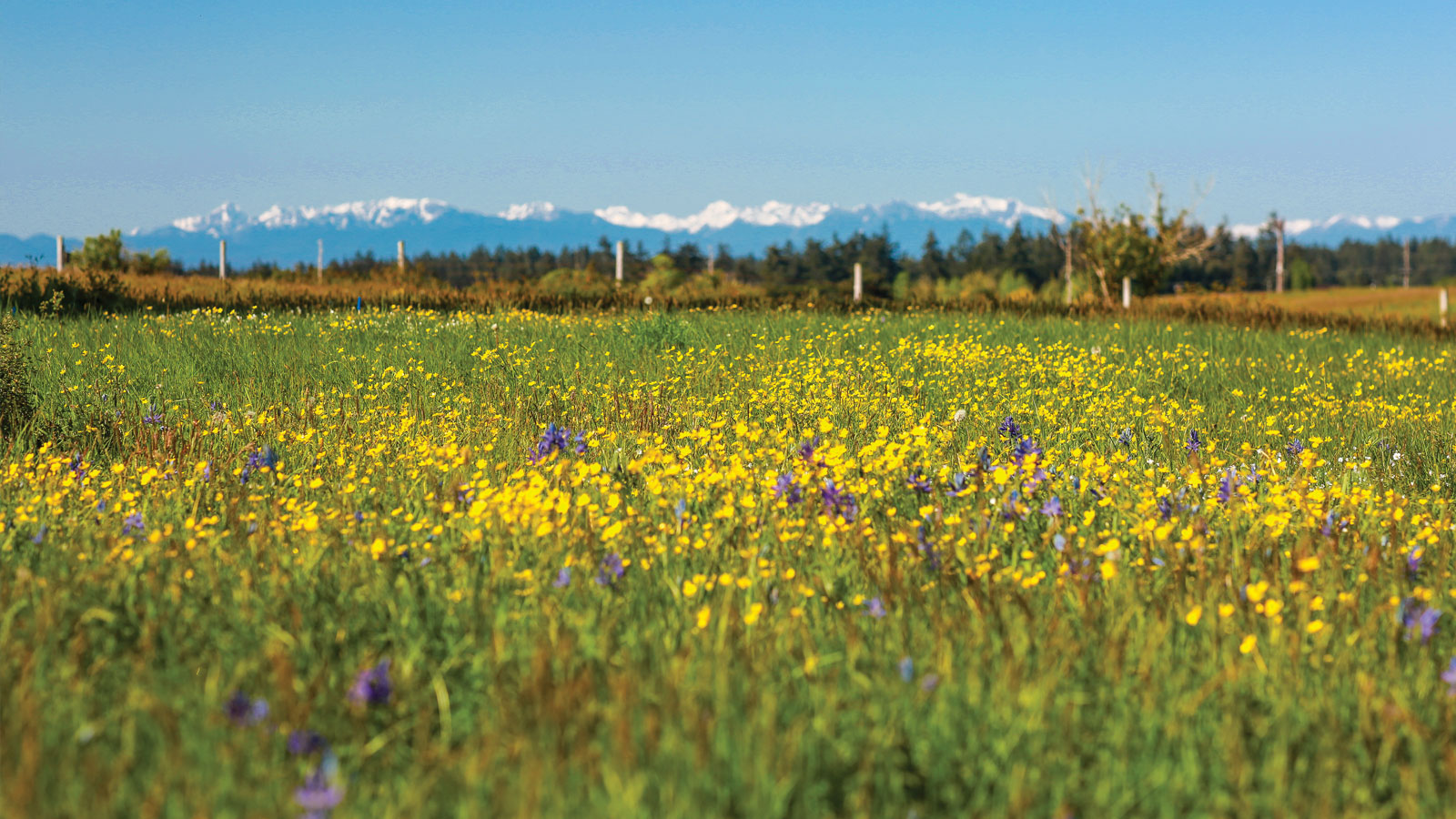
As you drive past the rolling fields on Whidbey, imagine the prairie that once existed and how it was and continues to be an intrinsic part of the island’s past, present, and future.
PRI’s core values have expanded to include a commitment to cultural justice, evident by the organization’s partnership with the Coast Salish Youth Coalition (CSYC). Every year, PRI is the site of the “Camas Bake” hosted by the CSYC. It’s an event focused on traditional uses of the camas plant—a cream-colored bulb that sprouts purple flowers—which had been a food staple for Indigenous tribes. “Camas is a true house-post [or pillar] of Coast Salish culture that holds up the structure of traditional foodways,” said CSYC Executive Director Sam Qol7ánten Barr. “It is spiritually fulfilling for all the tribal participants to revitalize the practice of harvesting, cooking, and eating these sweet camas bulbs.” The event started in 2018 with 12 people and now draws more than 100 from tribes across the region. It focuses on the various ways this root was prepared, used, and integrated into tribal life.
With tribal input, PRI has also been co-creating an extensive “Food Sovereignty Garden” for the purposes of growing traditional native foods and medicinal plants for tribal use, and for educating the public about the richness of Coast Salish foodways.
According to PRI Executive Director Muri Mitschak, PRI is collaborating with CSYC to explore how this land can be used once more by Coast Salish Peoples as a place for intertribal gatherings and the revival of traditional practices. “This relationship has taught us that when restoring the environment, we must consider both humans and the non-human elements of an ecological community,” she said.

As a nonprofit, PRI relies on funding from native plant sales, building rentals, workshops, grants, donations, and fundraising from its annual Cider Festival. It also hosts events for the community—fruit tree and vine pruning seminars in February, a Soil Science workshop in April, “Prairie Days” in May, and seed collection parties in the summer.
As you drive past the rolling fields on Whidbey, imagine the prairie that once existed and how it was and continues to be an intrinsic part of the island’s past, present, and future. Work is underway to establish this essential part of our identity, and those efforts are inspiring.
Founded in 2009, Preserve Purchased in 2015
Mission: Engaging science, culture, and community for ecological restoration.