Coupeville Wharf Celebrates 120 Years
Endangered to EndurinG
by Lea Cramer • Photos by Dave Meyer
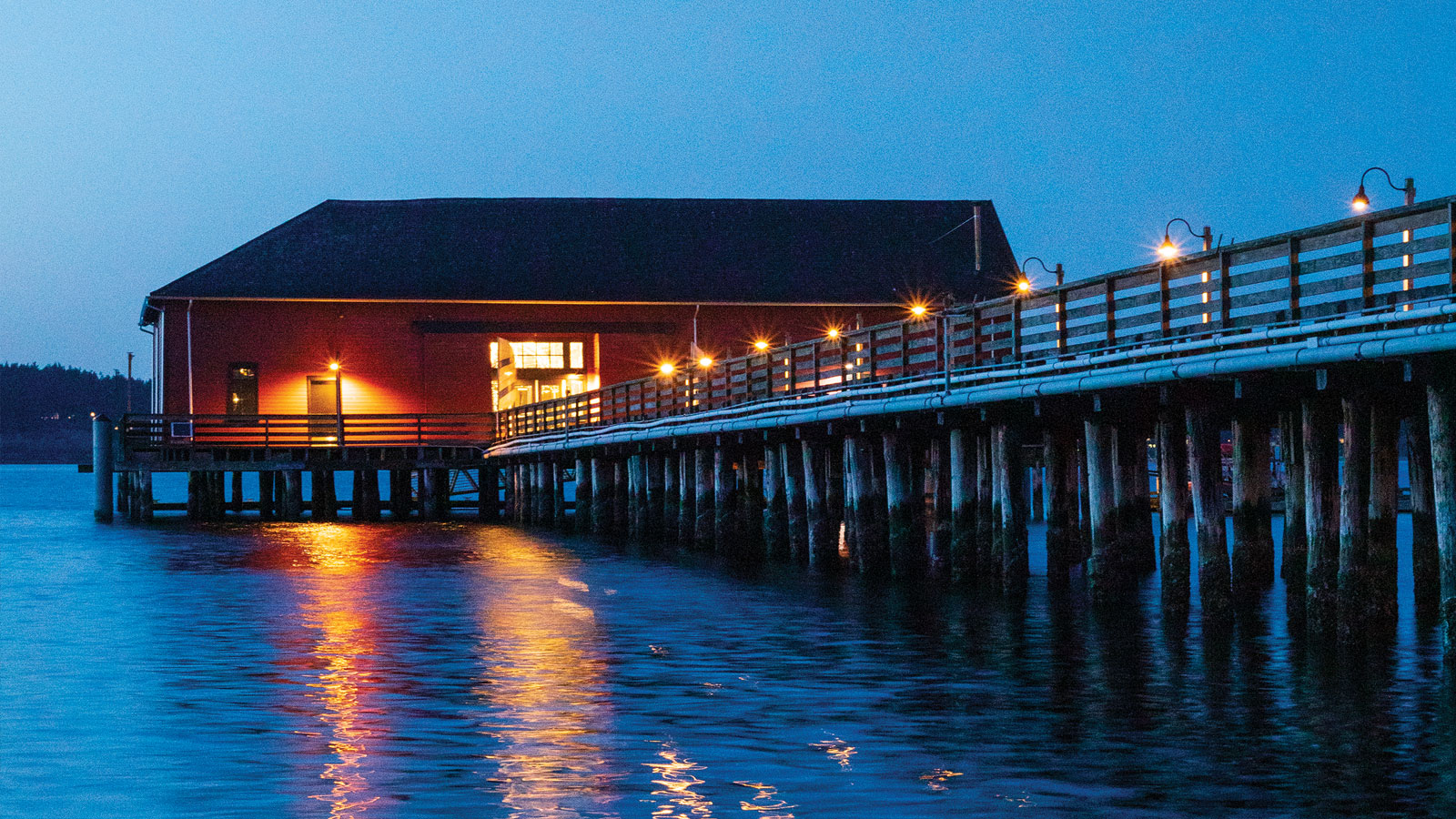
It rises resolutely from the rippling waters of Penn Cove—a vision of weathered wood and quiet resilience. The Coupeville Wharf, built in 1905, stands as both a literal and symbolic tether to the past—a bridge between Whidbey Island’s maritime history and the constant flux of its present. This year marks Coupeville Wharf’s 120th anniversary, and the community is invited to a historic anniversary party on Saturday, July 19th. The milestone will be celebrated in commemoration and active preservation of this aquatic sentinel, ensuring this icon endures against tide, time, and today’s demands.
Just as it would have in the early 1900s, the mist still rolls off Penn Cove, fingering the bleached timbers of Coupeville Wharf, a reminder of this landmark’s past. These stalwart supports have borne witness to a history brimming with tradition—the fishermen and farmers, whose faces were etched with the lines of hard labor and countless storms, or the Salish women in long skirts who brought baskets brimming with local produce to the Wharf. This history is all an intrinsic part of its identity. Here, amidst the bustle of this sleepy hamlet, life at the water’s edge feels eternal.

Coupeville is not a town that merely remembers its past—it wears it comfortably, like a well-loved cardigan, its fabric woven with the presence of the Coast Salish Indigenous Peoples ancestral history and the European settlers who came seeking a better future. The Wharf, Coupeville’s crown jewel, seems unassuming at first glance. However, this is no ordinary dock. It symbolizes an era when maritime commerce was the town’s lifeblood, a resilient bridge between past and present.
Originally constructed in 1905 by the Coupeville Wharf Company, the Wharf was a marvel of its time—timber pilings driven deep into the sea floor created a sturdy platform that became a nerve center for the town’s, and the island’s, economy. Built to accommodate schooners laden with timber, seafood, and agricultural goods, the Wharf quickly became a vital link between Whidbey Island and the mainland.
From the 1880s to the 1920s, the Mosquito Fleet ferries were crucial in supporting Whidbey’s agricultural economy and supplying military installations. Once a bustling dairy operation, Greenbank Farm—which is managed today by the Port of Coupeville—relied heavily on the Wharf as a primary hub for transporting milk and other farm products. Chris Michalopoulos, executive director of the Port of Coupeville, underscored the Wharf’s significance. “The Coupeville Wharf is one of the last structures from Washington’s Mosquito Fleet era. Similar wharves have succumbed to time and fire, but the Coupeville Wharf still stands.” It is the enduring heartbeat of Coupeville’s maritime history. One of the remaining Mosquito Fleet ships, the Virginia, will be at the Wharf dock during the anniversary party, with tours on board and cruises available to participants.
In 1930, Coupeville launched its first waterfront festival, a modest affair featuring Indigenous canoe races with just three participating teams.
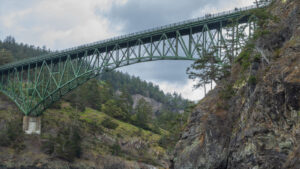
The Wharf’s L-shaped warehouse, documented in insurance maps as early as 1909, grew over time to accommodate waiting rooms, grain towers, and steamboat facilities. It was a working pier, its planks bearing the weight of fishermen, farmers, and ferry passengers. However, when Deception Pass Bridge opened in 1935—connecting Whidbey to Fidalgo Island and the mainland—the Wharf’s ferry service diminished. Within a couple of years, the steamboat era would draw to a close. Yet, the Wharf persisted, ever adapting to changing times.

In 1930, Coupeville launched its first waterfront festival, a modest affair featuring Indigenous canoe races with just three participating teams. The races fell into dormancy during World War II, but in the early nineties, thanks to the efforts of local volunteers, they returned as the Penn Cove Water Festival. Since then, the festival has grown, drawing as many as 22 tribes and turning Penn Cove into a vibrant stage for tradition, competition, and cultural exchange—a revival mirroring the Wharf’s resurgence.
By the mid-20th century, the Wharf had weathered time but not without injury, showing signs of aging. The Port of Coupeville took ownership in 1969, recognizing its historical and economic significance. Restoration efforts began in earnest, with relevant pier improvements in the 1970s. As with any active wharf, there are ongoing repairs to pilings, bulkheads, and the structure itself.
The Wharf was added to the Ebey’s Landing National Historic Reserve in 1987 and the subsequent decades brought modernization efforts to preserve the space, including the removal of grain towers, adding a marine store, a new roof, seismic stabilization, and fighting the ongoing battle against decay. In 2024, the Coupeville Wharf joined the Washington Trust for Historic Preservation’s Most Endangered Places List—a reminder of its fragility, the risks it faces due to rising sea levels, and the community’s determination to protect it.
Over the years, the Coupeville Wharf has played a significant role in the mussel industry. Penn Cove’s nutrient-rich waters provide an ideal environment for cultivating mussels, which are famous for their sweet flavor and soft, tender texture. Penn Cove hosts the oldest and largest commercial mussel farm in North America, Penn Cove Shellfish, and through the years, the Wharf has facilitated the growth of this thriving shellfish industry—providing crucial access for aquaculture businesses and commercial fishermen to bring their catches directly to market.
Additionally, the Wharf is a gathering place for mussel farmers, fostering community among those invested in the shellfish industry. Annual events like Musselfest highlight the significant economic and cultural contributions of mussel farming to Coupeville’s identity. As sustainability becomes an increasing focus in marine industries, the Wharf’s relationship to mussel farming also reflects broader efforts to promote environmentally responsible practices, ensuring the waters of Penn Cove remain a thriving source of bountiful harvests for future decades.

As it prepares to celebrate 120 years, Coupeville Wharf’s story is far from over. Susan Laarman, communications director for the Port of Coupeville, reflects on the challenges and triumphs of this phased restoration, including crucial structural improvements and historically accurate refurbishments. Many of the changes will go unnoticed. “A lot of the upgrades people won’t see, which is part of the goal—like the cap and piling foundation work that’s underwater and the new wood windows installed for the next hundred years.” Despite much of the work going unnoticed, these achievements are monumental in safeguarding the area’s heritage. In the coming years, the community will see further reinforcements—bulkhead and stair repairs, new floating docks, steel piles replacing aging wooden supports, a fresh coat of paint, and dredging. The future also includes a lift to protect against rising sea levels.
In addition to learning about the Wharf’s history, visitors can experience marine education up close. They can ring the whale bell when catching a glimpse of a passing marine giant, they can picnic in the sun with views of Mt. Baker, and they can take part in kayaking and sailing right from the Wharf. The space is both a nod to the past and an opportunity to immerse oneself in the moment. And the anniversary celebration, scheduled for summer 2025, is poised to be a milestone occasion to acknowledge the Wharf’s history as well as its place in the present and future of Coupeville. The ceremonial cutting of the ribbon will signal the completion of most renovations. The occasion is a nostalgic look back at the past, a continued commitment to preserve the town’s maritime heritage, and an opportunity to thank the community for its relentless support.
It is easy to mistake history for something static, a series of dates and events fixed in time. However, the Coupeville Wharf, with its seasoned planks and salt-laced air, reminds us that we inhabit and walk upon history with each creaking step. Here, where schooners once moored and paddlers still glide across shimmering waters, the past is not a relic but a current evolution carrying us forward. As Coupeville gathers to mark 120 years at this landmark, it does so with reverence in quiet defiance of time. The Wharf, like the tide, refuses to recede.