Heritage in Every Fiber
by Allyson Meyer • Photos by Dave Meyer
The fog settles over the green acres, hugging the treed perimeter and covering the landscape in a dewy, mystical softness. The pastoral fields, bathed in a muted sunlight filtered through the mist, seem akin to a scene out of a James Herriot book.
Yet, instead of the Yorkshire Dales, you’ll find yourself above the shores of Penn Cove at Wild Rose Farm, a sheep farm on Whidbey Island. Among 40 acres, 20 of which are leased from their neighbor, this family-owned farm is redefining shepherding with an eye towards the future, an emphasis on heritage, and, ultimately, a deep connection to the animals and the land.
Veterinarian Ken Leaman and his fiber artist wife Nan moved to Whidbey Island in 1992 with their small flock of sheep. Nan had discovered the island through her involvement with the nearby Pacific Northwest Art School, and the region just called to them. They settled on their farm a stone’s throw up from Penn Cove and opened an animal clinic in Coupeville. Raising four daughters on a working sheep farm, it was a sense of self-reliance that pulled them towards this path. “For us, it’s always been important for our children to know what a garden is, to know where their food comes from, and to know how to be resourceful,” said Ken.

Since then, the couple has devoted themselves to shepherding, bringing to the island long wool sheep breeds that grow high-quality wool fibers. Their work raising these heritage breeds, encouraging genetic diversity, and ensuring the wool comes from a variety of sheep has driven the couple’s efforts in building their own high percentage fiber flock.
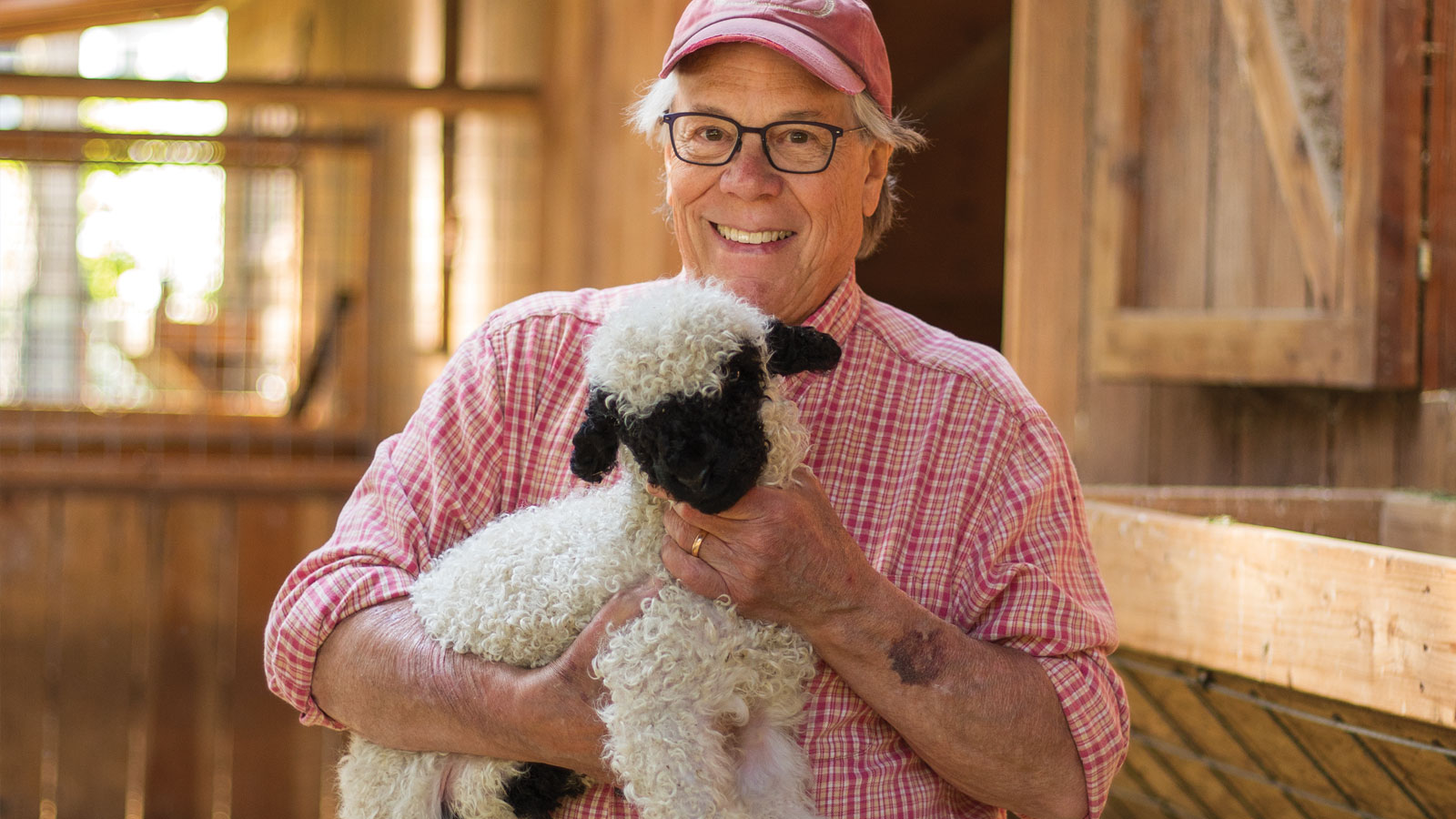
“The finest sheep are Merinos,” said Ken. “But they can’t live here.” Instead, the Leamans have focused on the fine wool of the heritage Wensleydale and Teeswater sheep, with their “long and lustrous” fleece. For the past few years, this has also included their work to establish purebred Valais Blacknose Sheep flocks in the United States. Dubbed “the cutest sheep in the world” with black, sock-like markings on their legs and long, curly wool covering their eyes, these sheep are native to Switzerland and known for their docile manner. Their coarser wool is better suited for blankets, rugs, and outerwear, and, unlike the Merino breed, Valais are better adapted for the Pacific Northwest climate. However, sheep cannot be directly imported to the United States from Europe—that’s where science came in.
Nearly six years ago, the Leamans embarked on a quest to establish a purebred Valais Blacknose Sheep flock in the U.S. through their Pure Valais, LLC business partnership with Oregon-based Shepherds Lane farm. This involved importing Valais frozen embryos from New Zealand and using their Teeswater ewes as surrogates. “It is quite a process, but that way you are able to get 100 percent purebred sheep born in the U.S. We started in 2019 and now we have quite a few different ram lines and we can focus on natural breeding,” said Ken. Just a few years in, they have seen the fruits of their labor pay off. In the spring of 2021, the first embryos were born. The following spring they saw their first “naturally conceived purebred Valais lamb” born in Oregon. Since then, the couple has continued to establish a genetically diverse breeding stock on their farm. “I have the benefit of being a veterinarian,” said Ken. “We can raise healthy, well cared for, beautiful sheep.” And these beautiful sheep, in turn, create highly sought after, rare wool fiber.
On property that has been used for agriculture for more than a century…a tradition that celebrates heritage and the land upon which their flocks graze.
“We have a line of blankets,” said Nan. “The wool goes off to the mill, it gets made into roving or yarn. It is then woven into blankets. It’s pretty wonderful. The fleece comes off the sheep and it’s just beautiful.”
“It’s rewarding when hand spinners love these fleeces. The reviews we receive are for the quality of wool and how happy people are with it. It’s pretty amazing,” added Ken. “The sheep all have personalities, and they all have names. So, if you buy a skein of yarn, you know it comes from Rosy or Stardust or whoever. The artists really appreciate that as well. It’s significant to them to know the animals are cared for.”

The Leamans’ flock of woolly creatures are guarded by the couple’s trusty Great Pyrenees as well as their long-necked and inquisitive llama guards. Even though the sight of the llamas juxtaposed with the smaller sheep companions may appear humorous, it’s clear they have a job to do. “They’re working llamas, and they serve as a deterrent to predators,” said Nan.
Although life on the farm may appear bucolic, it is hard work. Lambing season may be a favorite time of year at Wild Rose, but it is full of long days of caring for the ewes, stepping in with difficult deliveries, and bottle-feeding any “bummer” lambs rejected by their moms. But for the Leamans, they wouldn’t have it any other way. Being shepherds not only brings them immense happiness, but it also stays true to the island’s roots. On property that has been used for agriculture for more than a century, the Leamans are continuing a tradition that celebrates heritage and the land upon which their flocks graze. “On these 40 acres, you could have 20 houses here. When you look at the whole coastline of Penn Cove, it’s not overblown with houses, and we’re helping that. Plus, the sheep droppings are good for the land. Everything’s greening up right now. It’s just good to have open spaces,” said Ken. “Why do people come here from Seattle? Because there’s a certain feeling, even if you can’t write it down, there’s a feeling. You travel through Coupeville, and you see all the open space. That didn’t happen just by chance, and it makes people feel good.”


For Ken and Nan, their days are full of farming responsibilities, care for the animals, and, for Nan, a continuation of the fiber art that drew her to the loveable creatures at the heart of their farm. Her wraps, scarves, and frameable fiber art can be viewed at the Artworks Gallery in Langley.
It is a commitment to their calling that drives Ken and Nan forward, knowing their work is part of the very fabric of Whidbey’s identity—past, present, and future. They are fully aware they are shepherds for the next generation of farming and are building a legacy that is intrinsically connected to the land and the heritage sheep they love.