Experiencing the Beauty of Deception Pass
by Allyson Meyer • Photos by Dave Meyer
If you listen quietly, you can almost hear the history. It’s whispered softly over the salty ocean breeze. It’s in the creaking of the giant evergreens as they stretch their limbs toward the sun. And it’s fully present along the bluff, as you view the steep cliffs that hug the appropriately named water passage that is Deception Pass. Amidst the hiking trails, rocky beaches, and iconic bridge, Deception Pass State Park is a special place—capable of transporting a visitor back in time while ensuring they’re fully in touch with the present, and in fact, inspired by it.
Dedicated as a Washington State Park in July 1922, the park is located on the ancestral lands of the Coast Salish Indigenous Peoples. This Island County landmark has passed its centennial anniversary and remains a fixture in the region’s identity, hosting remarkable views of the nearby islands and boasting trails and campgrounds that continue to draw people in.
“Around 800,000 cars enter the park every year,” said Deception Pass State Park Area Manager Jason Armstrong. “During the peak of the COVID-19 pandemic, I think we tipped 3.4 million people in one year, but it’s pretty consistent between 3 and 3.2 million people.”
For Armstrong, the park is “a great place to learn how to camp,” with campsites booking out nine months in advance. Even with the high number of visitors each year, it never feels overly full, with the vast acreage allowing visitors to experience a strong connection with the park—something that keeps them coming back.

“It’s a great thing to be standing there knowing it hasn’t changed, and it’s not going to in the foreseeable future.”
“I enjoy the busy time of the year. It just feels like it’s alive. I do enjoy the off-season, because you can see all that growth coming back and the animals come out and explore more often,” said Armstrong. “But I do love the busy time of the season. You can connect with and learn about families who have been coming to the park for five and six generations, which is always amazing.”
The name of the park can be traced back to 1792. Originally thought to be an inlet by Captain George Vancouver, it was named “Deception Passage” after Chief Navigator Joseph Whidbey’s circumnavigation of Whidbey Island proved it was a deceptively disguised saltwater passage, rather than a river. Perhaps best known today for the striking two-lane bridge that connects Whidbey Island with Pass and Fidalgo islands, Deception Pass State Park falls within two counties—Island and Skagit—which is unusual.
“There are not many parks where half is in one county and the other half in another,” said Armstrong. “It’s interesting, because when you talk to people who have been around the community a long time, Rosario, Bowman Bay, and Deception Pass were three distinct parks. The decision was made that they would all become one park years ago. Even today, when you start talking with people visiting Deception Pass State Park, they don’t recognize it’s all one park. It’s about 4,500 acres, and they just don’t connect the dots.”

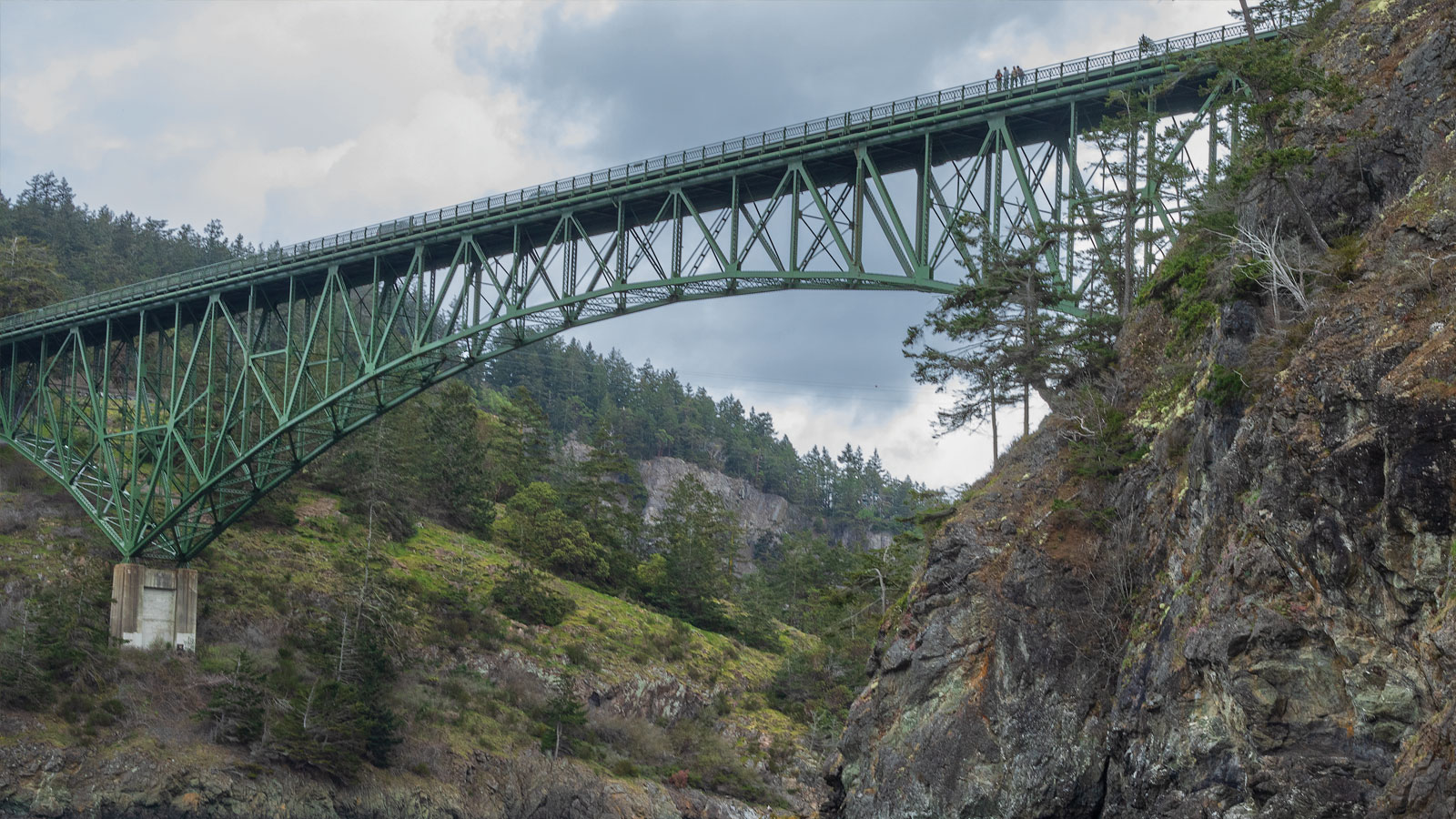
But one thing is certain, even if visitors aren’t aware of the size of the park, they most likely know one of its key features. “The bridge is a unique thing, because it’s obviously a significant draw for Deception Pass. It’s important to note that the Washington State Parks Department does not own the bridge. It’s owned by the Department of Transportation,” added Armstrong. “We get thrown into the mix because we own Pass Island. We own everything on either side, and the bridge is kind of an ancillary or necklace for us. It highlights the park itself.”
It is this steely green adornment to the park which draws visitors for sunset photo shoots on the walking path, darting glances down the approximately 180 feet below at the choppy waters and taking in the majestic beauty of the Pacific Northwest landscape. Built in 1935 for under one million dollars and with help from the Civilian Conservation Corps, the bridge, along with numerous areas within the park, is included in the National Register of Historic Places. With its cantilever construction, more than 1,500 tons of steel were used in the construction of the bridge, which took less than a year to construct. A few years ago, just repainting the bridge its iconic “Evergreen Green” shade took three years and around 21 million dollars to complete.
It isn’t just the bridge that draws people to the park, it’s also the landscape. With more than 14 miles of scenic coastline, three lakes, and countless historical landmarks, entering the park is like stepping back in time to the 1930s as preparations for the bridge began.
“To me, the best kept secret is hiking in the old-growth forest over Hoypus Hill. If you walk all the trails, it’s possible you could hike it and not see another person. If you like that serenity and seclusion, it’s quiet and peaceful.”
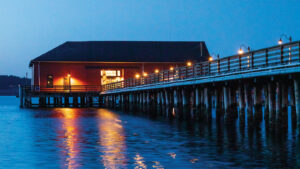
“Bowman Bay is my favorite location. It is close to what it looked like when the park formed, so it’s always intriguing to be able to step into a place that has barely changed in a hundred years,” said Armstrong. “It’s a great thing to be standing there knowing it hasn’t changed, and it’s not going to in the foreseeable future.”
Efforts are underway to restore portions of the shoreline to the way it was a hundred years ago and to ensure that the prairie balds—the treeless and rocky areas near Goose Rock that are important habitats for biodiversity—are protected. “What’s interesting about Goose Rock is it has these balds up there and we tried to find a way to protect them,” said Armstrong. “We decided we were going to put up a substantial fence. We ended up having a volunteer group in 2022 that hand-carried 435 10-foot split rails to the top of Goose Rock. Over a hundred volunteers helped us, and we built an entire fence to protect the balds in one day, which was remarkable.” Called the Goose Rock Challenge, each volunteer received a special Goose Rock wooden medallion for their help that day.


With its stunning topography and a chance to escape to the seclusion of its many hiking paths, this iconic landmark continues to attract visitors and locals. From the prairie balds at Goose Rock, the highest point on Whidbey Island, to the crystalline clear waters of the coastline, the park continues to inspire and surprise.
“To me, the best kept secret is hiking in the old-growth forest over Hoypus Hill. If you walk all the trails, it’s possible you could hike it and not see another person. If you like that serenity and seclusion, it’s quiet and peaceful,” said Armstrong.
It is these connections to the environment and the appreciation for the park that keep bringing people back. For generations, it has been a gathering place and an ever-present celebration of nature and our space within it. So, as park visitors come for the first time or return for the hundredth, Deception Pass State Park is firmly rooted in the island’s identity, calling us once again to come experience the wild.