On Familiar Waters
Captain Larson’s Career in Service
By Allyson Meyer • Photos by Dave Meyer
Waiting at the Clinton Ferry Terminal, you can see the snowcapped Cascade mountain range glow in the distance and, closer to home, a resident seal bobs up and down in the teal waters of Possession Sound. It’s a brilliant, sunny day—perfect for being out on a boat. Today’s vessel of choice, the Washington State ferry Tokitae. It’s a fitting name for a ferry that has served Whidbey Island for over a decade. Named for the Southern Resident orca Tokitae that was captured during the 1970 orca capture in Penn Cove, the ferry has been in service in the Pacific Northwest since 2014.
There’s nothing quite like a ferry to put island living into perspective—the iconic white and green vessel, with a gaping mouth that resembles a whale shark; the sound of the fog-splitting horn that is carried effortlessly through the air on particularly murky days; and the dance of the cars loading and unloading, heeding the calls from ferry staff directing their every movement.
Riding the ferry is both quaint and essential, magical and utilitarian. Living on Whidbey means relying on the Mukilteo/Clinton and Coupeville/Port Townsend ferry routes or crossing the Deception Pass Bridge to come and go from the island. For many, life here is intrinsically connected to the waterways, and the modes of transportation that take people to the mainland and bring them back to our shores.
Waiting at the Clinton Ferry Terminal, you can see the snowcapped Cascade mountain range glow in the distance and, closer to home, a resident seal bobs up and down in the teal waters of Possession Sound. It’s a brilliant, sunny day—perfect for being out on a boat. Today’s vessel of choice, the Washington State ferry Tokitae. It’s a fitting name for a ferry that has served Whidbey Island for over a decade. Named for the Southern Resident orca Tokitae that was captured during the 1970 orca capture in Penn Cove, the ferry has been in service in the Pacific Northwest since 2014.
There’s nothing quite like a ferry to put island living into perspective—the iconic white and green vessel, with a gaping mouth that resembles a whale shark; the sound of the fog-splitting horn that is carried effortlessly through the air on particularly murky days; and the dance of the cars loading and unloading, heeding the calls from ferry staff directing their every movement. Riding the ferry is both quaint and essential, magical and utilitarian. Living on Whidbey means relying on the Mukilteo/Clinton and Coupeville/Port Townsend ferry routes or crossing the Deception Pass Bridge to come and go from the island. For many, life here is intrinsically connected to the waterways, and the modes of transportation that take people to the mainland and bring them back to our shores.
At the helm of the Tokitae part of the time is Whidbey Island resident and longest serving Washington State Ferries (WSF) fleet Captain Curtis Larson. Larson, who began his career nearly 50 years ago, has earned the distinction of Commodore, the title given to the most senior Master (or Captain) in the fleet. It’s awarded for longevity in a ferry system that has been in existence for 75 years and, for Larson, the title “carries a lot of responsibility.” It’s recognition for service and a reminder of the years dedicated to these iconic ferries.
“Tokitae’s continued success is not only due to the hard work and dedication of our deck and engine crews. The terminal staff brings us the passengers and vehicles we transport. Our Eagle Harbor Repair Facility tradespeople maintain our vessel during the year and our annual shipyard period. Operations, dispatch, vessel and terminal engineering and countless other shoreside management teams support us and do whatever it takes to keep us sailing. Without them we wouldn’t be the greatest marine transportation system in the country.” —Captain Curtis Larson
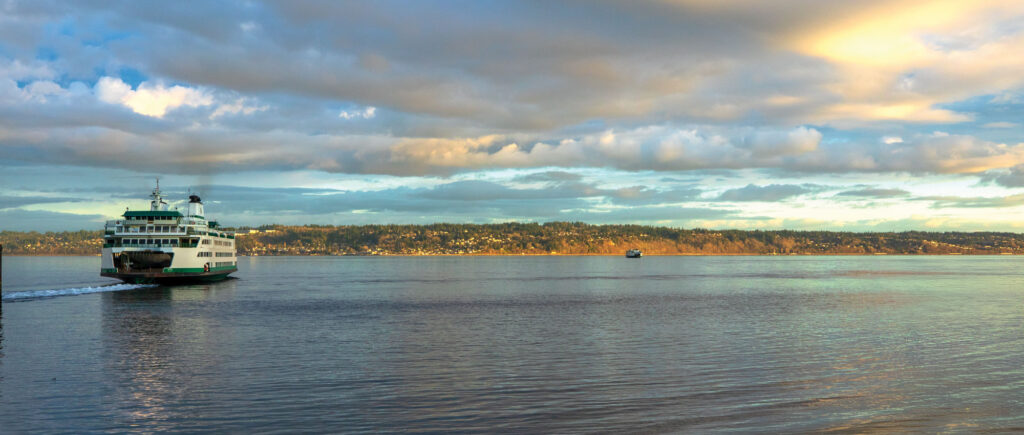
A Washingtonian by birth, Larson grew up in Edmonds but felt Whidbey’s pull early on. His family roots on the island go back more than a century, and he spent many weekends on his grandparents’ property in Greenbank. As a fourth-generation islander, Larson felt called to a career in public service that directly benefited the place he called home, a role that has not always been easy, but has strengthened his connection to the community.
It was memories from childhood ferry rides—like the ringing bells of the engine order telegraph (EOT) that, from the back seat of the family car, Larson recalls vividly. “I clearly remember the sound of the EOT sending engine propulsion commands from the pilothouse to the Chief Engineer in the engine room. There were what looked to me like large bicycle chains on the car deck overhead that connected the pilothouse EOT to the engine room EOT. When those chains moved back and forth, there were bells that sounded down below.” Today, those “archaic” systems have been replaced with modern technology. It’s a reminder of how much the ferries have changed during Larson’s lifetime, and how WSF will continue to change to address an aging fleet and workforce, hybrid-electric power, and other upgrades.
In the summer of 1975, Larson began his ferry career in entry-level positions and worked his way up through the Able Seaman school in Seattle, took endless Coast Guard exams, survived Marine firefighting school, and completed several other first responder training programs. In 1991, Larson completed the exams needed to become a Master/First Class Pilot, or Captain, within the ferry system.
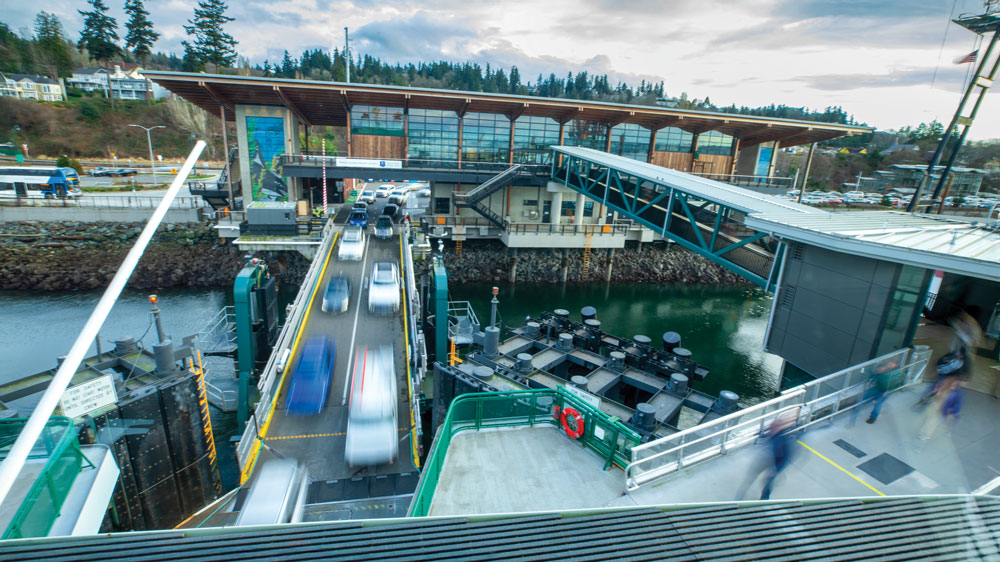
Having worked almost every job imaginable on the ferries, Larson has a special connection with all his crew. Inviting us to tour the ferry from top to bottom, it is clear there is a camaraderie and sense of family among his team. From the car deck employees and the Engineers to the Chief Mate, Second Mate, and the concession and galley staff the bond is tangible. Larson jokes with them, checks in on them, and has earned the special abbreviated moniker of “Cap.”
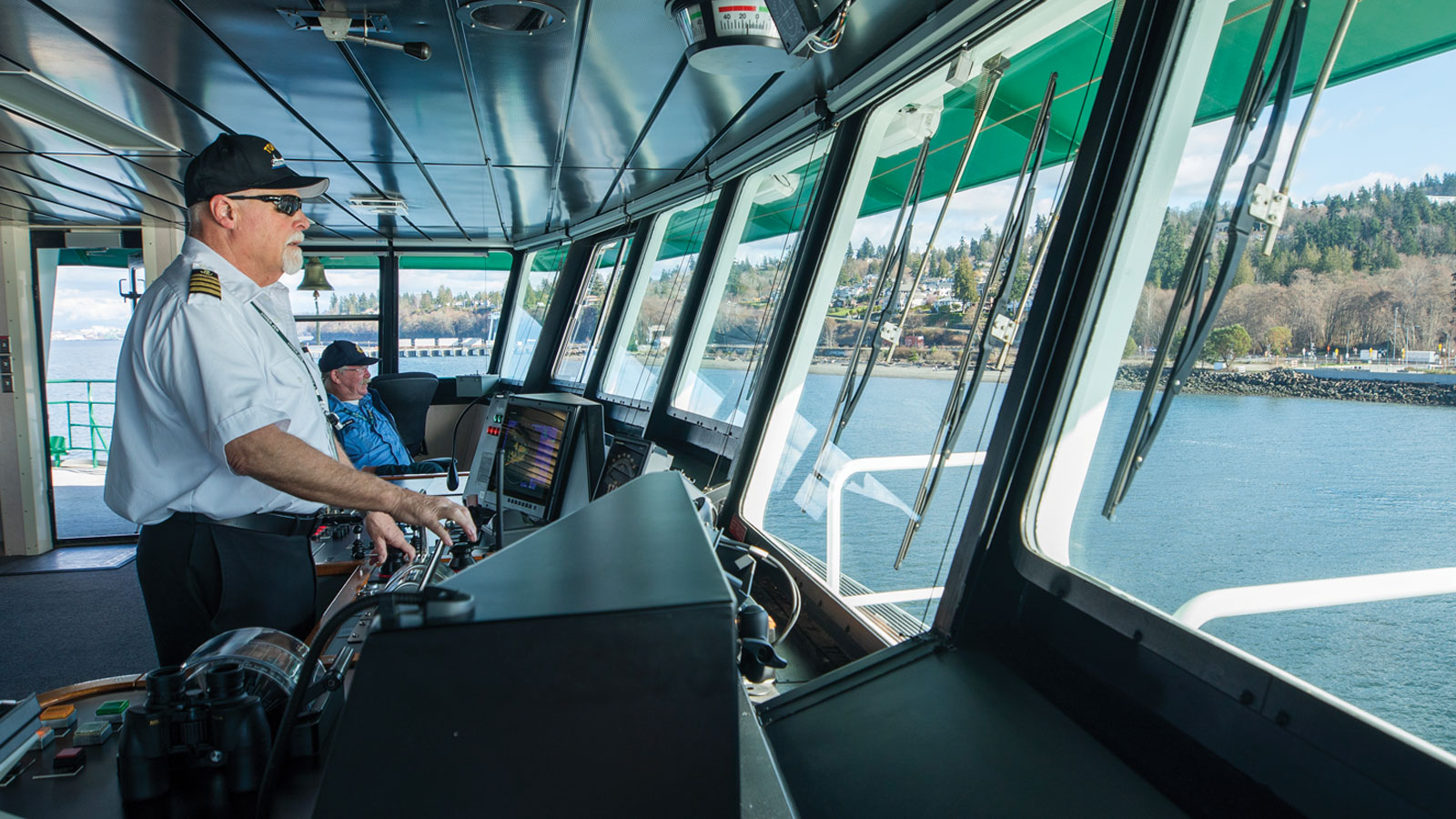
From his vantage point in the pilothouse, Larson has a bird’s-eye view of the waterways—literally, as seagulls dip and soar within reach from the deck just off the pilothouse. It’s been nearly five decades of “stunning sunrises and sunsets” and seeing marine life like orcas and gray whales never gets old. From the pilothouse, the ferry ride is a completely different experience than on the car or passenger decks. The gentle hum of the engine below is magnified as the constant vibration stays with you long after you disembark. It’s both melodic and powerful as the ferry slices through the water, leaving only a churning wake. Panoramic windows frame the sweeping views, which on clear days allow you to see both Mount Baker and Mount Rainier off in the distance.
“The Engineers and crew work 24/7 to keep the boat running and in the best mechanical condition possible. If something needs repair, they can do it on the spot or sometimes overnight. Most passengers have no idea what they do and how valuable they are. That crew of four is so vitally important in keeping the Tokitae in top shape while we move passengers back and forth efficiently and safely. Without their expertise and commitment to excellence we, above decks, would not be able to do what we do.”
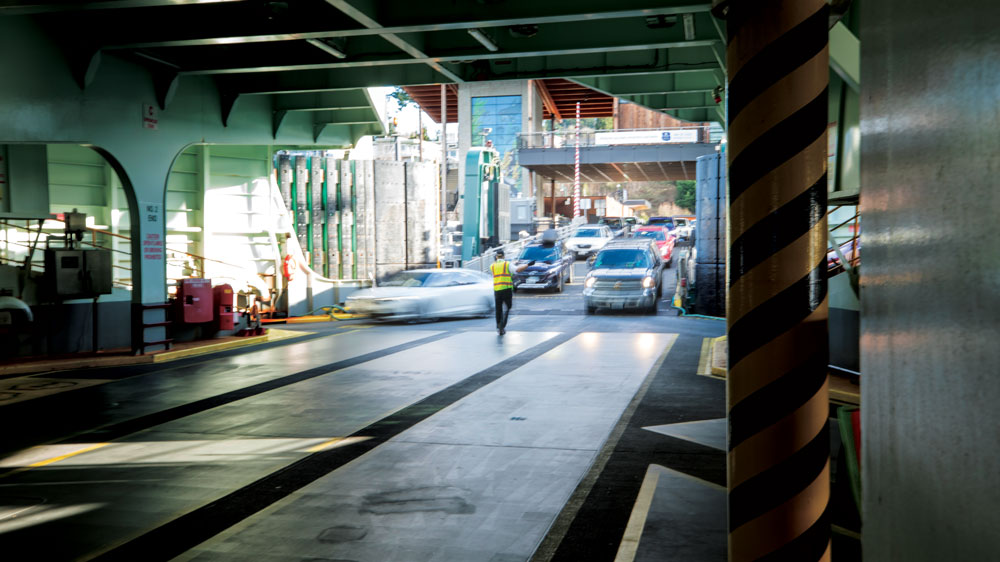
Larson’s usual shift of afternoons and evenings on Tokitae is a standard nine days on and five days off. When he arrives for his shift, he relieves the morning watch Captain, checks in with his deck and engine crew, and assumes his position in the pilothouse. “When we’re getting ready to depart Clinton, I head to the offshore pilothouse on the Mukilteo end of the vessel. The Chief Mate and I share watch standing duties throughout the day.”
Larson makes all eastbound crossings, while his Chief Mate takes the westbound trips. They also share landings, with Larson at the helm for all Mukilteo arrivals while his Chief Mate makes most of the landings at Clinton. Appreciation for his crew is evident. “I am very fortunate to have one of the very best Chief Mates in the system, Chris Johnson.” Adding about the engine department, “The Engineers and crew work 24/7 to keep the boat running and in the best mechanical condition possible. If something needs repair, they can do it on the spot or sometimes overnight. Most passengers have no idea what they do and how valuable they are. That crew of four is so vitally important in keeping the Tokitae in top shape while we move passengers back and forth efficiently and safely. Without their expertise and commitment to excellence we, above decks, would not be able to do what we do.”
Once the vessel has left the terminal and cleared the dolphins—the large, black pilings that ease the ferry into dock—Larson walks between the exhaust stacks to the other pilothouse. He has a unique 12-year relationship with the vessel, knowing it well. He navigates the crew-only inner workings of the ferry—hidden stairwells, engine control room, boiler room, crew staterooms, and galley—with an affinity for the vessel he’s called home for the past decade. His is a protectiveness and sense of pride for the ferry that serves Whidbey Island.
“I’m responsible for the safety of the passengers, vessel crew, the vessel itself, and protection of the environment. I feel a strong connection to the South Whidbey community in many ways,” he said. “Over the past couple years, I worked on a project to bring the memory of the orca Tokitae aboard the vessel. I worked with the Orca Network, community members, and WSF management to install a beautiful mural of Tokitae that is displayed on the Clinton end of the passenger cabin. It is striking.”
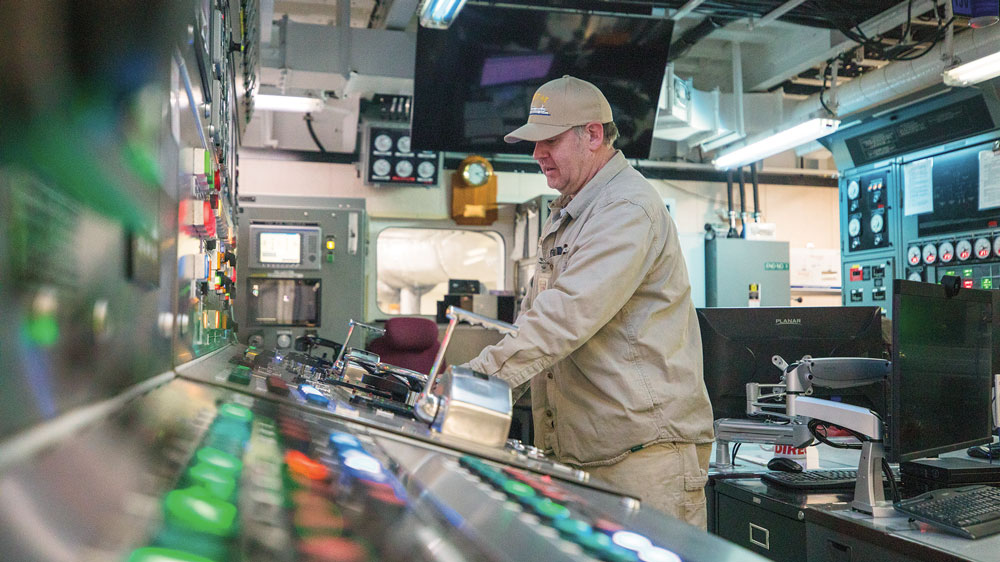 Staff Chief Engineer Brady Ferguson below the car deck watches over the many controls of the ferry
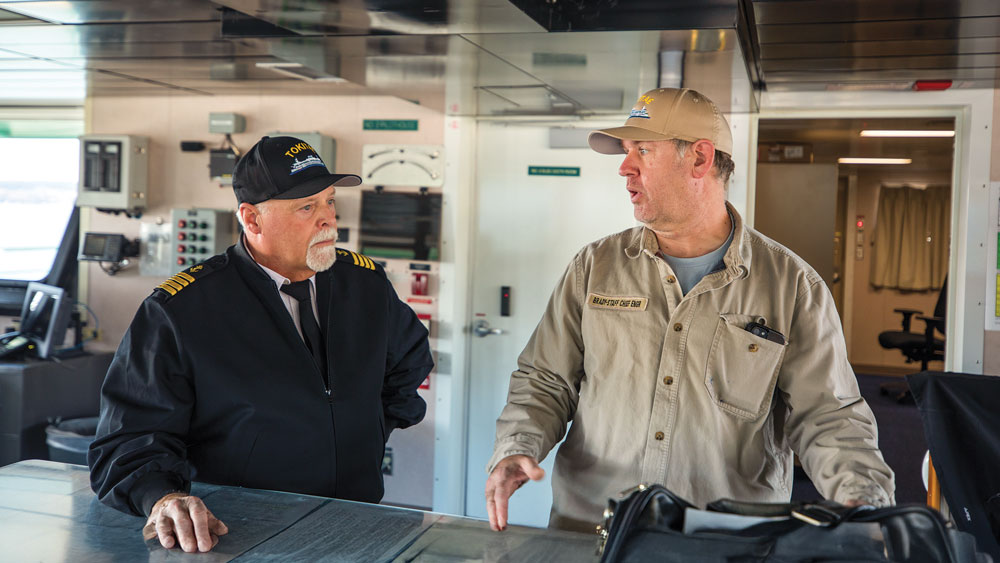 Captain Larson confers with Staff Chief Engineer Brady Ferguson on the bridge of M/V Tokitae
Up Before Dawn
Before the very first passengers board any of the vessels in the Washington State Ferries fleet, the engine room is already hard at work. The Staff Chief Engineer Brady Ferguson leads Tokitae’s crew members who monitor and maintain this critical part of the ferry’s infrastructure. Their days start hours before most of the passengers are even awake. It’s a necessary part of the process, which keeps the ferries running smoothly and safely for up to 20 hours a day. But it’s a part of the ferry that passengers don’t see. They don’t know that down a steep set of ladders, the engineers are hard at work seven days a week for 12-hour shifts, monitoring their controls, communicating with the Captain, and keeping everything moving with equipment repairs and replacements. They have a fully functioning workshop, welding station, and parts supply on board—because, when something needs to be fixed, it has to happen quickly and efficiently. The engine room crew may be unseen by those who ride the ferries every day, but they are an essential part of the equation.
- Staff Chief Engineer Brady Ferguson below the car deck watches over the many controls of the ferry
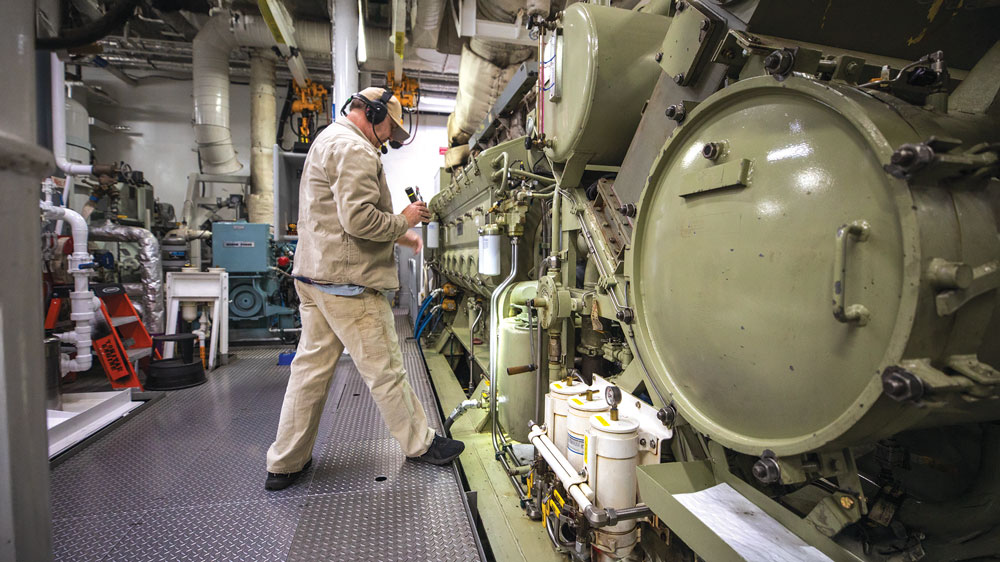 Staff Chief Engineer Brady Ferguson below the car deck inspects of of the two engines that constantly run to power the ferry
While visiting his grandparents on the island in 1970, he and his brother witnessed the orca capture from Madrona Way just off Penn Cove. It’s a full circle moment for this Captain, who now holds the title of Commodore and is at the helm of the ferry dedicated in Tokitae’s honor. In addition to this, Larson has worked directly with South Whidbey Elementary School to connect youth with the ferry. Third graders wrote “inspirational letters to the local community and made beautiful origami stars that were displayed on the windows of the Tokitae.” Larson and his crew then invited the students and chaperones to visit the pilothouse for a tour.
“I asked one of the third graders in the pilothouse that day, ‘Would you like to do this someday?’ He said, ‘Yes!’ I told him to work hard in school and if he really wants to be a Captain, he can do it.”
It’s moments like these that generate nostalgia for a long-time ferry Captain looking towards the future. “I love what I do, but retirement is coming up,” he said. “It’s going to be bittersweet because of how much I enjoy what I do, but I have a family to catch up with—three children and six grandchildren.”
Although he may be looking ahead to retirement, there is still a reverence and appreciation for the work that he carries with him each time he boards Tokitae. “When I go to work, my goal is to be the best Captain, mentor, and leader I can be. I care about our passengers and want them to have a safe and enjoyable trip. They rely on WSF to provide that. It’s our responsibility to get our passengers to work, medical appointments, and wherever they’re headed.”
For the longest-serving fleet Captain, it’s been a five-decade journey that has brought him closer to the island he loves and the community—both on land and water—that he cares deeply about.
Special thanks to Washington State Ferries, Captain Curtis Larson, and the crew of the Tokitae for their help with this story.