Finding HOPE on Horseback
By Kate Poss • Photos by Dave Meyer
Diagnosed with cystic fibrosis early in her life and extremely immunocompromised, seven-year-old Anna Baumgart rarely spoke to others outside of her family until she met Griffin, a horse in Langley’s HOPE Therapeutic Riding Program. For a second-grade school project, Anna submitted a drawing of herself with Griffin. Titled “Being with Griffin,” she described how her relationship with the horse helped her find a place of belonging. “Griffin always listened to me and let me be me,” she wrote. “He helped me in my early days of speaking to people and showed that it is okay to be brave in trying new things.”
Nikki Baumgart, Anna’s mom, first found the HOPE program online over a year ago when searching for a horse-riding opportunity for her daughter. She contacted one of HOPE’s instructors and spoke with them for an hour, seeking assurance that Anna would be safe. Nikki had grown up riding horses in Wisconsin and had told stories to her daughter about her adventures as a young girl. Anna had never actually ridden a horse.
“I was very worried that they would have the right horse,” Nikki recalled on a blustery weekend afternoon in Langley. “We wanted to find a place that was a good fit and were willing to drive to find it.”
Diagnosed with cystic fibrosis early in her life and extremely immunocompromised, seven-year-old Anna Baumgart rarely spoke to others outside of her family until she met Griffin, a horse in Langley’s HOPE Therapeutic Riding Program. For a second-grade school project, Anna submitted a drawing of herself with Griffin. Titled “Being with Griffin,” she described how her relationship with the horse helped her find a place of belonging. “Griffin always listened to me and let me be me,” she wrote. “He helped me in my early days of speaking to people and showed that it is okay to be brave in trying new things.”
Nikki Baumgart, Anna’s mom, first found the HOPE program online over a year ago when searching for a horse-riding opportunity for her daughter. She contacted one of HOPE’s instructors and spoke with them for an hour, seeking assurance that Anna would be safe. Nikki had grown up riding horses in Wisconsin and had told stories to her daughter about her adventures as a young girl. Anna had never actually ridden a horse.
“I was very worried that they would have the right horse,” Nikki recalled on a blustery weekend afternoon in Langley. “We wanted to find a place that was a good fit and were willing to drive to find it.”
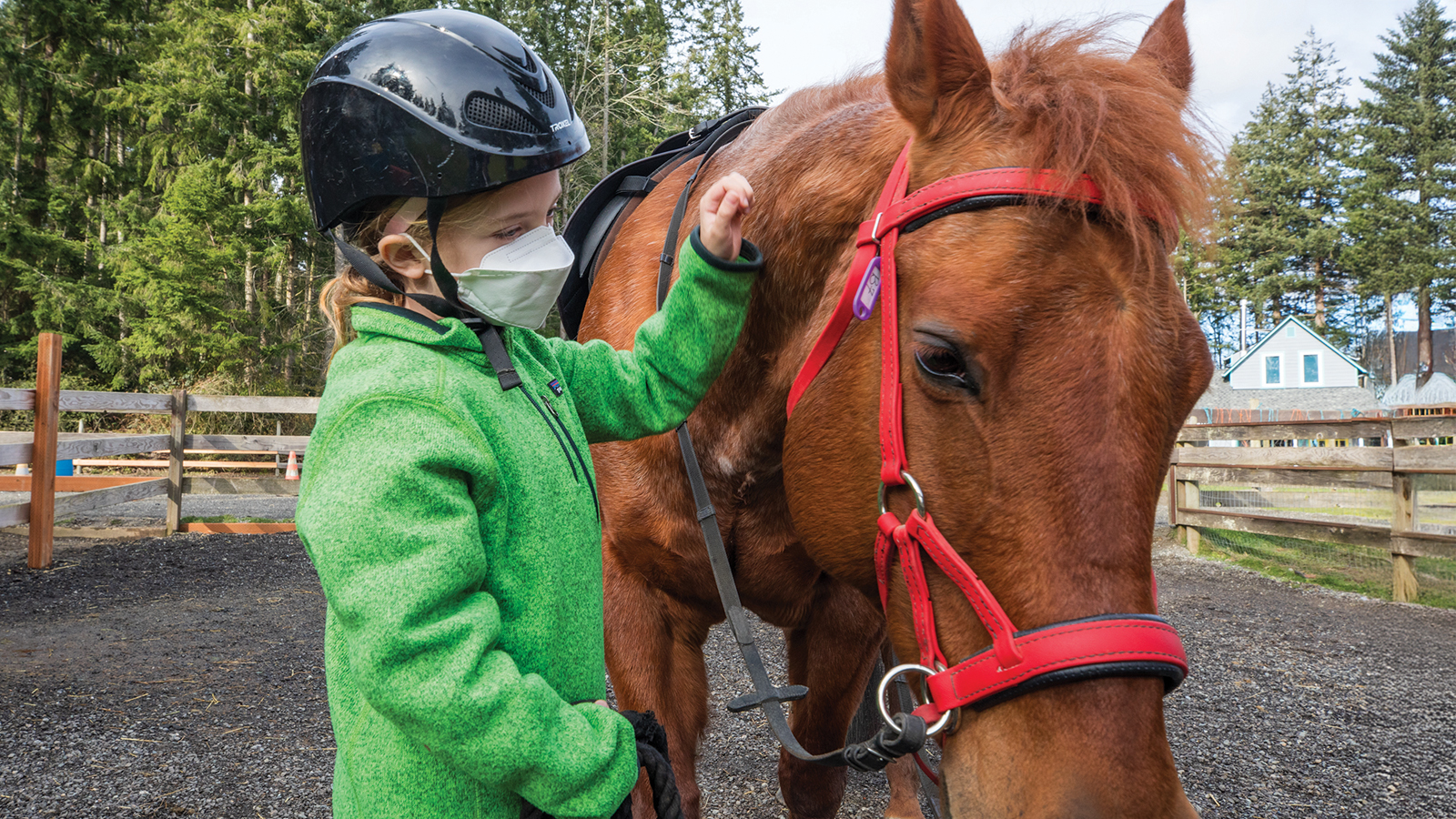
She walked right up to Sunrise, a sociable mare, and stroked the horse’s shaggy brown-red coat. Feeling Anna’s touch, Sunrise closed her eyes halfway and gently leaned into the little girl.
Nikki, husband Sergei, and Anna drove to Langley from Seattle for this story. Typically, HOPE’s therapy classes are held spring through fall at the Whidbey Island Fairgrounds and Events Center. Now in operation for more than four decades, HOPE is a member of the Certified Horsemanship Association, or CHA, and its instructors are CHA certified instructors of riders with disabilities. The nonprofit’s mission is “to empower children and adults facing special challenges—whether physical, cognitive or emotional—to discover their abilities, independent skills and explore their potential through use of our nationally accredited safe and effective equine assisted activities and therapy.”
For this weekend visit, the Baumgart family met at Jodi Leuenberger’s Langley farm. Growing up on South Whidbey, Leuenberger rode with the Pony Club in the 1990s and volunteered with HOPE as a young girl. She left Whidbey for a while and then returned to the island 14 years ago. Now she is HOPE’s executive director and lead horse therapy instructor. Early on Leuenberger noticed Anna’s natural comfort around the equines. “That’s the power of Anna; someone the horses feel naturally calm around.”
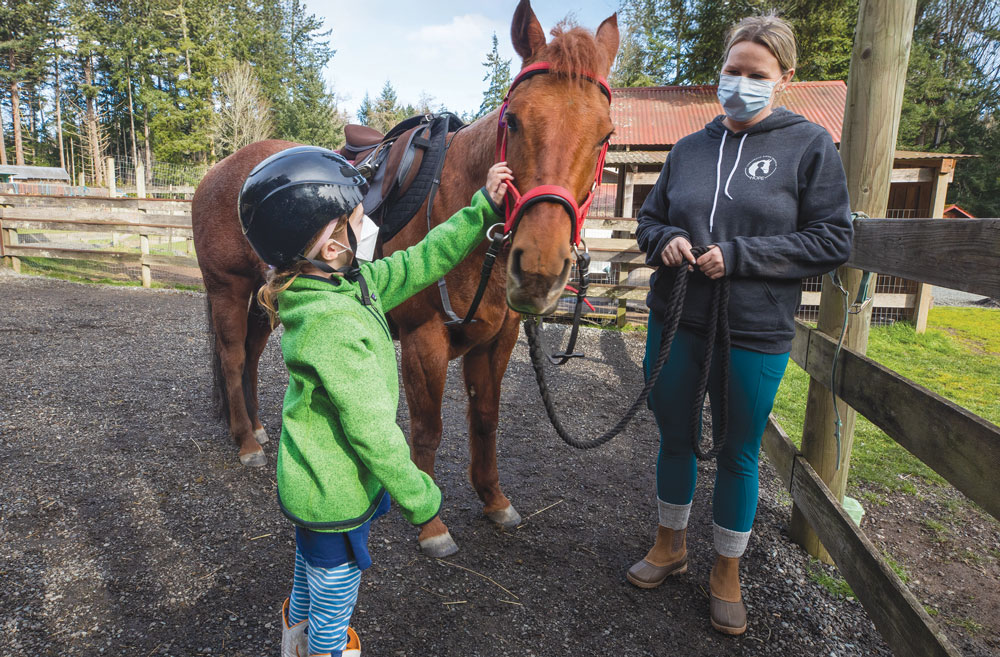
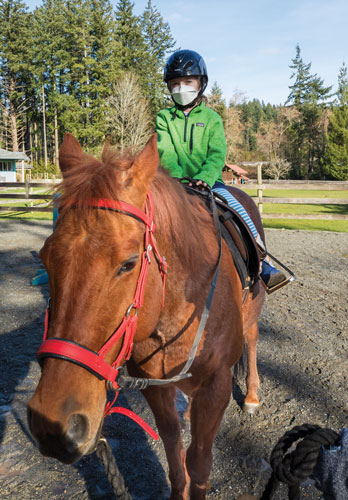 Anna takes Sunrise for a walk around the paddock.
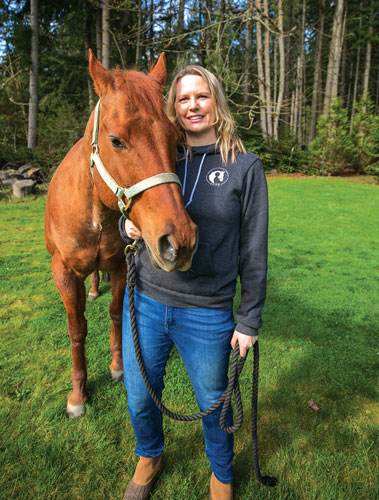 Jodi Leuenberger, executive director of HOPE Therapeutic Riding Program, with Sunrise
The nonprofit’s mission is “to empower children and adults facing special challenges—whether physical, cognitive or emotional—to discover their abilities, independent skills and explore their potential…”
It’s been over a year for Anna in her experience with HOPE and its horses. On this day, she walked right up to Sunrise, a sociable mare, and stroked the horse’s shaggy brown-red coat. Feeling Anna’s touch, Sunrise closed her eyes halfway and gently leaned into the little girl.
Leuenberger and volunteer Juliet Moncrief, who has volunteered with HOPE the past two years, walked with Anna and Sunrise into the arena. Anna—wearing a neon green jacket, helmet, blue striped leggings, and blue and white cowgirl boots with orange flames—received a lift from Leuenberger into the saddle.
“She has a nice personality,” Anna said of Sunrise.
“She does for you,” Leuenberger replied. “For me, she swishes her tail and can be bossy.”
“Anna’s a horse whisperer,” Moncrief added, recalling her amazement when witnessing Anna talking to her first HOPE horse Griffin.
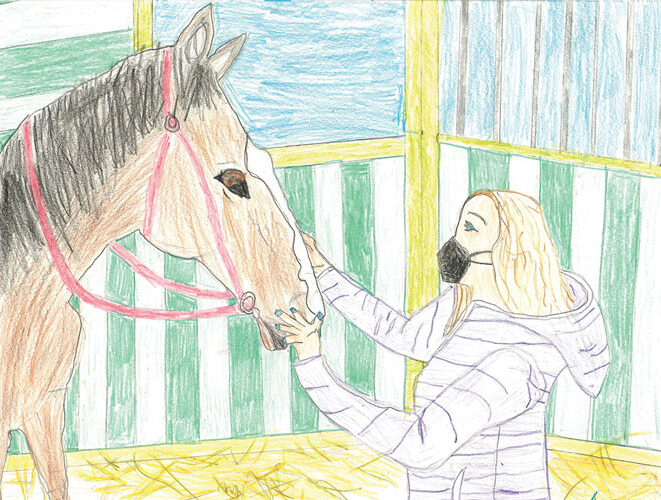
During this visit, Anna’s innate connection with the horses was on full display. After riding Sunrise, Anna moved on to Dobby, a frisky white horse with winter-furred legs. She had never ridden him before, yet walked right up to him, giving him calming pats on his side. Like Sunrise, Dobby relaxed under Anna’s touch
Horses are uniquely attuned to their rider’s emotions, making them excellent therapy animals, explained Leuenberger, who remarked that HOPE’s horses have a calming effect on riders of all ages and needs. “We have a nonverbal rider who is wheelchair bound,” explained Leuenberger. “He taps the horse to keep riding and stretches out his legs, which can get stiff from sitting in the chair.”
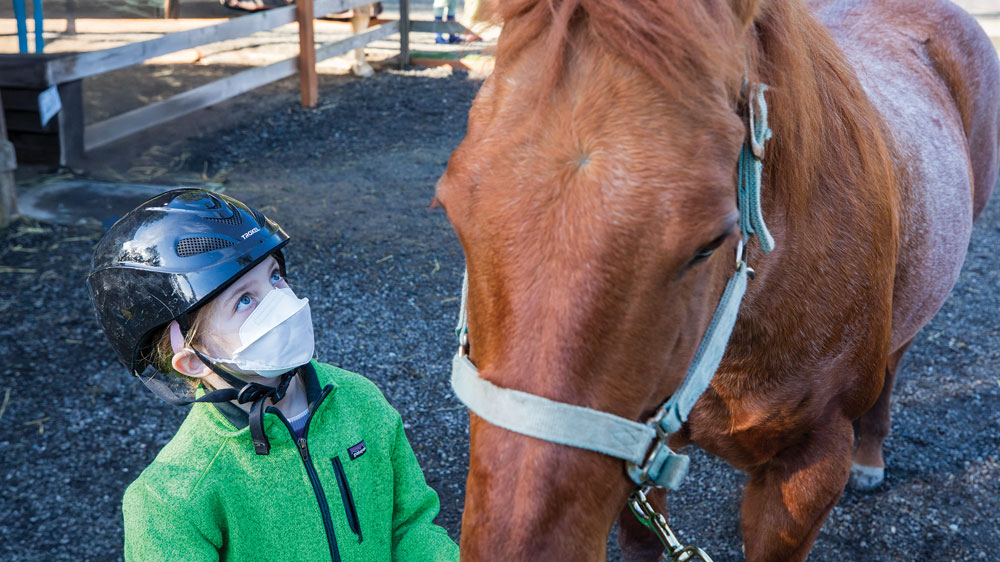
During the regular HOPE sessions, volunteers, instructors, and up to eight horses work with riders—who number between 15 and 19 for the weekly, hour-long lessons. For the HOPE program, it’s all about enabling riders to discover their abilities. The organization meets with students and families to discuss goals, create lesson plans specifically designed for each rider, and chart progress from every visit.
Besides riding the horses, participants are also taught responsibilities, like brushing and feeding the horses and caring for the equipment. For Anna, this includes helping muck out the horse barn. Having been cared for all her life due to her medical condition, Nikki reflected that, for her daughter, “caring for the horses is really liberating.”
Early on, Nikki was amazed to see a rider with a prosthetic leg taking lessons. “It’s moving to watch,” she said, adding that she enjoys the welcoming and encouraging community at HOPE, and what it has done for her family. “During the summer Anna tried trotting—it was very freeing for her.”
Rooted in a strong connection between rider and horse, this program is heavily volunteer-driven, with the community intrinsically connected in everything from fundraising to horse sponsorship. HOPE Therapeutic Riding welcomes volunteers and donors to help maintain its program for the next generation of riders. For more information, visit hopewhidbey.com.