Musical Craftsmanship
By Mary Reddy • Photos by Dennis Browne
In earlier centuries, people would not travel far from the village where they lived. Local merchants provided the necessities. Each town had its baker, cobbler, dry goods store, and blacksmith. Now we have opportunities to travel abroad; we can purchase products online and have them shipped to us from afar. But local artisans bring us back to the neighborhood, where personal engagement is the reward.
A luthier is one of these craftspersons and a highly skilled one at that. The term comes from the French word for lute, an instrument which shares ancestry with the guitar. In August 2024, the south end of Whidbey Island gained its own luthier, Darrell Pope. He named his shop The Village Luthier with the idea the “community needs a local musical instrument person.” Musicians active in the island’s vibrant music scene have proven him correct.
Pope started playing guitar when he was 25 and began to fiddle with the instrument, making minor adjustments or adding a pick-up. Both his grandfather and father had woodworking shops where he learned to use the tools of the trade. Years passed before he returned to working with wood, instead making use of his undergraduate
In earlier centuries, people would not travel far from the village where they lived. Local merchants provided the necessities. Each town had its baker, cobbler, dry goods store, and blacksmith. Now we have opportunities to travel abroad; we can purchase products online and have them shipped to us from afar. But local artisans bring us back to the neighborhood, where personal engagement is the reward.
A luthier is one of these craftspersons and a highly skilled one at that. The term comes from the French word for lute, an instrument which shares ancestry with the guitar. In August 2024, the south end of Whidbey Island gained its own luthier, Darrell Pope. He named his shop The Village Luthier with the idea the “community needs a local musical instrument person.” Musicians active in the island’s vibrant music scene have proven him correct.
Pope started playing guitar when he was 25 and began to fiddle with the instrument, making minor adjustments or adding a pick-up. Both his grandfather and father had woodworking shops where he learned to use the tools of the trade. Years passed before he returned to working with wood, instead making use of his undergraduate and graduate degrees in mathematics in IT consulting. Eventually, he began to consider a second career path.
Pope didn’t know what to expect at first, but business has been fairly steady. “I’m just coming up on my 300th instrument so far. I’d say a quarter to a third of the instruments are electric and the rest are acoustic.” The work ranges from simple tasks, such as attaching strap buttons on ukuleles to minor surgery on guitars. What brings instruments into his shop? Frequent playing can wear down the frets—thin, metal strips. Instruments exposed to cold temperatures or extremely dry air can develop cracks, weakened glue joints, protruding fret ends, or a sinking soundboard. Acoustic guitar strings exert about 170 pounds of tension which can, over time, cause the neck to pull up. Pope is adept at diagnosing and repairing—bringing the instrument back to life.
Repairs aren’t the only reason to seek his help. With the exception of high-end boutique guitars, a factory-produced instrument is set up with a specific intent. “The whole idea is when you pick up a guitar in a store, they don’t want that instrument to buzz; they don’t want it to rattle. So, it’s going to be heavily built. The action will be very high, making it harder to play. Even if you spend $5,000 on a guitar, if it’s a factory instrument, it will need adjustment.” Pope likens this to buying a suit off the rack and getting it tailored to fit your specific measurements. “One of the best things that ever happened to me was when I started to take lessons, my teacher said, ‘you need to take your guitar and get it properly set up.’”
A luthier is one of these craftspersons and a highly skilled one at that. The term comes from the French word for lute, an instrument which shares ancestry with the guitar.
Pope has a hypothesis that there is at least one stringed instrument per household on the island. He enjoys seeing people bring in old classic instruments that have been cared for but could use some freshening up. “I had a guy in here with a 1932 Martin last summer” who was delighted to see his shop. Another customer brought in a 1965 Gibson J45 in fairly good condition. But over time, the frets developed divots and he had to press harder to avoid buzzing, causing grooves to develop in the wood. Pope plans to replace the frets after re-leveling the wood of the neck to the appropriate radius. The oldest instrument he has worked on is a 1916 Gibson mandolin.
Pope and his wife moved to Whidbey Island from Milwaukee in 2017. They wanted to live in a place where “you get up every day, look around, and think, ‘Oh my God, this is so nice!’ Then we discovered we love the community even more.”
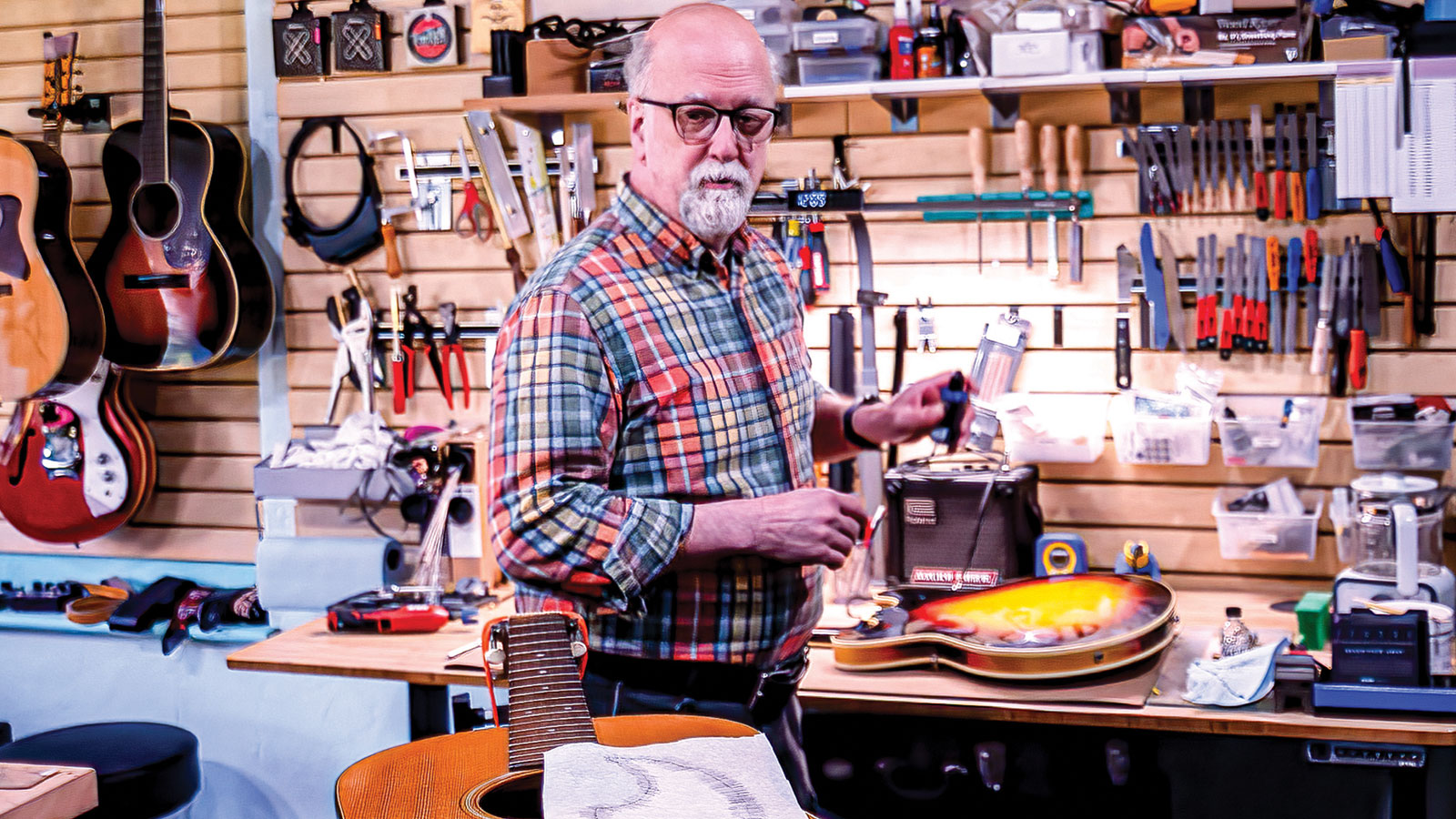
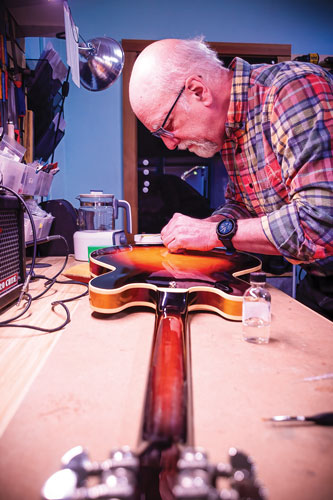 Whidbey Island luthier Darrell Pope repairs an electric guitar.
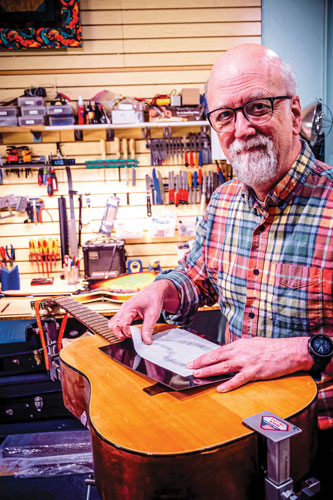 Whidbey Island luthier Darrell Pope repairs guitars in his Langley workshop.
He can talk at length about his musical favorites. Pope has a deep appreciation for guitar greats like Leo Kottke and Michael Hedges and speaks with enthusiasm about renowned guitar makers and pioneering luthiers. As a luthier, he combines his love of music, his woodworking skills, and a talent for problem solving. “I’m really comfortable with analytics and numbers. I have an appetite for continued problem-solving in analytics, but I want it to involve some creativity as well.” His problem-solving nature shines through in his use of a 3-D printer. He designs and prints objects to fill specific needs, for example, a jig that facilitates sanding bone to an exact thickness for guitar saddles and nuts.
Pope continues to hone his skills; he plans to become a guitar maker. His shop will be closed in July 2026 while he studies with a master guitar builder in Quebec. “It’s exciting. It’s going to the next level in terms of being able to adapt an instrument to a person’s playing style.” In early August 2026, Pope will begin offering custom guitar building.
It’s been a journey of discovery for Pope, who combines his love for stringed instruments and woodworking with a community-focused approach rooted in history. To follow along on his luthier path, visit thevillageluthier.com.